Electrician Facebook Ads: How to Promote EV Charger and Solar Services in 2027
On this page 8 sections
Key takeaways
- EV charger installation tasks rose 192% year on year in 2026, making it a timely ad focus
- Bundle charger, solar and switchboard ad sets separately to match where each customer is in their journey
- Short vertical videos of real installations outperform stock imagery for licensed electrical work
- Lead forms should ask about EV model, property type and existing solar to filter tyre-kickers
- Publish an indicative price range to improve lead quality but always explain what affects the final cost
- Track leads by placement and suburb, not just total volume, to know what is actually working
EV charger and solar installations are pulling electricians into a new high-value market. Airtasker reported a 192% year-on-year spike in EV charger installation tasks from January to September 2026, while solar requests climbed 81% over the same period. Facebook ads can turn this demand into booked site assessments, but only if you structure your account, creative and lead qualifying properly. This guide shows you how to run profitable electrician Facebook ads for charger work, solar integration and home energy upgrades.
Why EV Charger and Solar Jobs Are Worth Advertising on Facebook Right Now
EV charger and solar jobs are worth your ad spend because they sit at the intersection of high customer intent and genuine growth. Airtasker EV charger installation demand data 2026 shows the market is moving fast, and importantly, one in eight customers requesting charger installation also mentioned solar. That overlap means you can sell bundled services and cross-upgrade customers who already have solar but want to charge an EV from it.
Energy Networks Australia Connecting Australia Part 1 (November 2026) reported that 157,957 EVs were sold in Australia between January and June 2026 alone, with public charging locations growing 235% year on year. At the same time, 254,664 rooftop solar systems were connected in 2025, and 507,651 home batteries installed through the Cheaper Home Batteries Program. This is not a niche market. It is a structural shift in how Australian households buy electricity and power their vehicles.
The demand spike you should know about
The numbers tell the story. EV charger tasks on the Airtasker marketplace nearly tripled year on year in 2026. Solar installation requests jumped 81% in the same period. These are not forecasts; they are real customer searches happening now. Facebook and Instagram reach people in your service area who are asking for these services every week, and they are willing to pay for licensed, professional work.
Why these jobs suit paid social over search
Search ads (Google, etc.) work well when someone types "EV charger installation near me" or "solar electrician [your suburb]." But Facebook and Instagram reach people earlier in their journey. Someone scrolling Instagram at 7 p.m. might see your video of a charger installation and think, "That is what I need"—before they have searched for anything. Visual creative, carousel ads showing before and after, and testimonials from other EV owners all perform better on paid social than search alone. Marketing strategies for electricians that combine search and social consistently outperform search-only campaigns.
How to Structure Your Ad Account for Electrical Services
Structure your Meta ad account into separate campaigns and ad sets by service type and audience segment, not by geography alone, so you can measure and optimise each vertical independently.
Separate ad sets for each service type
Create distinct ad sets for EV charger installation, solar installation or solar optimisation, battery system integration, and switchboard or load-management upgrades. Do not lump them all into one ad set. Each service has different creative (a charger installation video looks very different from a solar roof video), different qualifying questions, and different customer timelines. EV charger buyers often move faster than solar customers. By separating them, you see which service drives the most booked assessments and where your budget should grow.
Audiences: who to target for charger and solar ads
Use Meta's Lookalike audiences built from your past customers, combined with Detailed Targeting for home and vehicle interests. Target people aged 25 to 65+ who have shown interest in electric vehicles, solar energy, home renovation, or sustainability. Exclude people outside your service postcode or state. Use Meta lead ads vs website forms to test which format captures the best leads, and use how to get better leads from Facebook ads to understand how to filter low-intent responses early.
Suburb and service-area targeting
Narrow your geographic targeting to suburbs or postcodes you actually service. If you cover a 30 km radius from your base, map those postcodes into Meta's location targeting rather than running national campaigns. Meta's Advantage+ placements will expand your reach, but start with tight geography so you do not waste budget on people you cannot reach within your acceptable travel time.
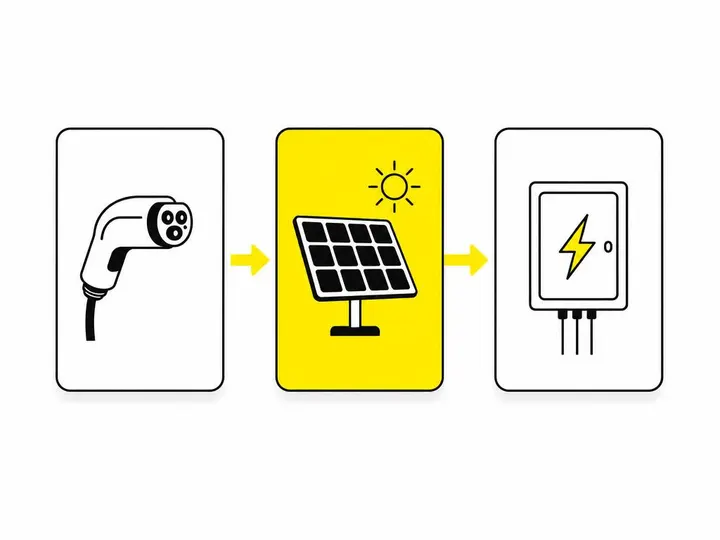
What to Show in Your Electrician Facebook Ads
The right creative dramatically improves ad performance because electricians who show real, licensed work get more trust and better leads than those relying on stock imagery.
Short vertical video: what to film on site
Film 15-second to 60-second videos on actual job sites. Show the switchboard, the cable run from switchboard to charger location, the wall-mounted charger being installed, the final setup with lights on, and a quick customer testimonial or close-up of the charger ready to use. Vertical video (9:16 or 1:1 aspect ratio) performs best on Instagram Reels, Facebook Feed and Stories. Avoid voiceover if possible; use captions and show the work. People scroll fast, so grab attention in the first 2 seconds with a visual: a hand holding the charger, sparks, or the customer smiling next to the installed charger.
Carousel ads for the full home energy upgrade
Carousel ads work brilliantly for electricians because each card can show a step: existing switchboard assessment, solar setup overview, charger installation location, finished charger, and a call-to-action card offering a free site assessment. Carousel ads also allow you to test creative formats that work for local businesses and compare performance across different card sequences. Meta reports which cards drive the most clicks, so you refine fast.
Why stock images hurt licensed tradies
Generic stock photos of chargers, solar panels or electricians undermine your credibility. Customers hire licensed electricians for safety and compliance. A photo of a real switchboard at a real job site signals that you have done this work before. It also makes your ad stand out against competitors using the same stock library. Invest 30 minutes filming on your next job and you will see the difference in lead quality.
Writing Ad Copy That Pre-Qualifies the Lead
Effective ad copy attracts genuine buyers and filters out tyre-kickers by being transparent about process, cost and what qualifies a job for your service.
Using an indicative price range without overpromising
A typical 7 kW single-phase home charger installation costs approximately $1,200 to $2,300 according to Solar Choice EV charger installation price index, but final cost depends on switchboard capacity, cable run length, load management and local network upgrades. In your ad copy, you can say: "EV charger installation from $1,200 to $2,300. Final cost depends on your switchboard and cable distance. Book a free site assessment." This sets expectations and attracts people serious enough to pay. It also protects you from customers who assume all installations cost the minimum.
Qualifying questions to include in your lead form
Use Meta Lead Ads with questions that filter low-intent responses. Ask: "What EV model do you own or plan to buy?" (This signals genuine intent; dreamers often skip it.) "What is your property type: house, unit, townhouse?" (Units require different approvals.) "Do you have existing solar?" (Leads to cross-selling.) "Where is your switchboard located?" (Affects cable run cost and feasibility.) "When do you want the charger installed?" (Next month vs. next year tells you urgency.) These questions look harmless to the customer but weed out people who are just curious or months away from deciding.
Headline and hook ideas for EV and solar ads
Try these tested angles: "EV Charger Installation [Your Suburb]", "Charge Your Car. Keep Your Power Bill Low.", "Solar + EV Charger: The Complete Upgrade", "Your Switchboard is Ready. We Make Sure.", "Free EV Charger Site Assessment". Hooks that work mention time (next week), problem (power bill, slow charging, waiting for permits), or outcome (charge at home overnight, offset your EV cost with solar). Avoid generic claims like "best prices" or "10 years experience"; instead, mention specific credentials like "Licensed Electrician", "CEC Accredited", or "Network-Approved Installer".
Handling Meta's Automation Tools in 2026
Meta is rolling out automation rapidly: Advantage+ placements, AI-assisted creative and campaign setup, and Threads integration into default placements. Use these tools to speed up testing, but do not rely on them blindly.
Advantage+ placements and what to watch
Advantage+ campaigns automatically expand your ads across Facebook, Instagram, Audience Network, Messenger and Threads. For electricians with limited budgets, this can dilute results because Threads placements may not drive local site visits. Instead, use which placements to use for tradie ads to identify which placements (Instagram Feed, Facebook Feed, etc.) deliver the most booked assessments, then restrict Advantage+ or manually select placements and monitor them weekly. Meta's automation is a tool, not a substitute for your own reporting.
Creative testing: multiple posts in one ad
Meta is testing a feature where you upload multiple published posts and Meta shows each person the version it thinks will perform best. For electricians, this is powerful: upload three videos (charger installation, solar assessment, battery readiness) and let Meta test them. Report back after two weeks and see which creative (and therefore which service hook) drives the most qualified leads. This speeds up your learning cycle.
AI-generated creative and the paused terms change
Meta paused its updated terms changes (originally planned for 20 November 2026) related to Self-serve Ad Terms and Ad Creative Generative AI Terms. Until new terms are confirmed, avoid relying solely on Meta's AI-generated ad copy or imagery for your electrical business. AI can mislead on safety claims, pricing and licensing. Write your own headlines, use your own job-site photos and video, and use AI as a brainstorm tool only, not as a final deliverable.
What budget makes sense for a local electrician?
Start with $500 to $1,500 per month per service type to test whether your creative, copy and targeting work in your area, then scale if you hit your target cost per booked site assessment.
If you run three ad sets (charger, solar, battery), you might allocate $200 to $400 per ad set for the first four weeks. Track which one delivers assessments under your target cost (e.g., under $80 per assessment). Once you find a winner, reduce spend on the underperforming ad set, pause it, or rebuild the creative and test again. When and how to increase your ad budget outlines the guardrails for safely growing spend as your data improves.
Budgeting and Measuring Your Electrician Facebook Ads
Measure success by cost per booked site assessment, not by clicks or impressions, because an electrician's real revenue comes from jobs booked and completed, not leads alone.
Metrics that matter: cost per booked site assessment
Set up Meta Pixel on your website and define a custom conversion event: "Site Assessment Booked" (when a customer confirms an appointment). Track this conversion, not form submissions alone. Many form fills never convert to booked jobs. After four weeks of data, calculate your cost per booked assessment (total ad spend divided by booked assessments). If it is below $100 and your average assessment leads to a job 50% of the time, then your cost per job is roughly $200, which is affordable if your average charger installation gross profit is $400 to $600.
How to scale when you find a winner
Once an ad set delivers assessments consistently below your target cost, increase budget by 20 to 30% per week until cost per assessment rises. That is the natural ceiling for that ad set and audience. Then create new ad sets (new geographic area, new service type, new creative) and repeat. This prevents budget waste and keeps profitability in focus.
Use Facebook ads for trade businesses and how electricians get more local leads to understand the full funnel from ad click to booked job, then optimise backwards from your target profit per job.
Conclusion
EV charger and solar installations are real, high-value electrical work that Facebook ads can reach affordably and fast. The market is growing (192% year-on-year for charger tasks), customer intent is genuine, and the overlap between solar and EV owners creates genuine cross-sell opportunities. Structure your ad account by service type, use real on-site video and carousel creative, write copy that pre-qualifies leads with transparent pricing and qualifying questions, and measure success by booked site assessments, not clicks.
Start with a modest budget ($500 to $1,500 per month per service), test your creative and targeting, find which ad set delivers assessments below your cost target, and scale the winner. Watch Meta's automation tools, Advantage+ placements, AI-generated creative and Threads expansion but do not let them override your own reporting and geographic targeting. Your electrician business survives on booked jobs, not automaton convenience.
The practical next step: film one real charger installation or solar site visit this week, test it in a Facebook ad to your local postcodes with a $300 budget, and track leads for two weeks. You will know within days whether paid social works for your electrical business.