How to Follow Up Website Leads: A Simple Process for Australian Businesses

On this page 9 sections
Key takeaways
- Respond to every website enquiry within 1 hour where possible
- SMS outperforms email for local service follow-up in Australia
- Most leads need 5 to 8 touchpoints before they book
- A written script removes inconsistency from your team handover
- Tracking lead source and response date stops revenue falling through the cracks
Most Australian tradies and small business owners watch enquiries come in every week, then wonder why they never convert into actual jobs or sales. The truth is brutal: you're not losing leads because your product or service isn't good enough. You're losing them because someone else picked up the phone faster, or sent a message while your potential customer was still thinking about the problem you solve.
Why Most Australian Businesses Lose Leads Before They Even Try
The gap between a customer hitting "send" on your website form and your business taking action is where most deals die. You might think a lead sits in your inbox waiting for you, but your customer is already shopping around. They've probably contacted two or three other businesses the same day. Whichever one calls back first wins the job, regardless of who has the better Google reviews.
The gap between enquiry and action
When someone fills out your website form, they're in a buying mindset right now. Not tomorrow. Not after you check your emails at 3pm. Right now. If you don't respond within the first hour, you've already lost the psychological edge. Your competitor, who has a simple system in place, just answered their phone and booked the job.
This isn't guesswork. HubSpot sales research on lead response times shows businesses responding within an hour are seven times more likely to qualify a lead than those waiting 24 hours or more. For Australian tradies, that difference translates to thousands of dollars in lost work every single month.
What happens while you wait
While you're busy on a job site or dealing with other tasks, your new lead is calling your competitor. They're comparing prices, checking reviews, and making a decision. Even if your quote is better, you've already lost the race. Speed-to-lead (the time between receiving an enquiry and your first contact) isn't just about politeness; it's about winning business. Studies show that 55% of deals go to whoever responds first, not whoever offers the best service.
In Australia, Sensis Digital Pulse Report on Australian SME digital habits found 78% of local customers expect a response within 24 hours. Most don't. That's your edge if you can be faster.
The Golden Window: Why Speed-to-Lead Matters
Speed-to-lead is the single biggest factor separating businesses that convert leads into jobs from those that don't.
The 1-hour rule explained
You don't need to call back within one hour for every lead, but you need to acknowledge them. An automated message saying "Thanks, we got your enquiry, we'll call you by tomorrow morning" takes 30 seconds to set up and costs nothing. It tells the customer you're real, you're listening, and they haven't been forgotten. From there, you have a real window to call or text them while they're still hot.
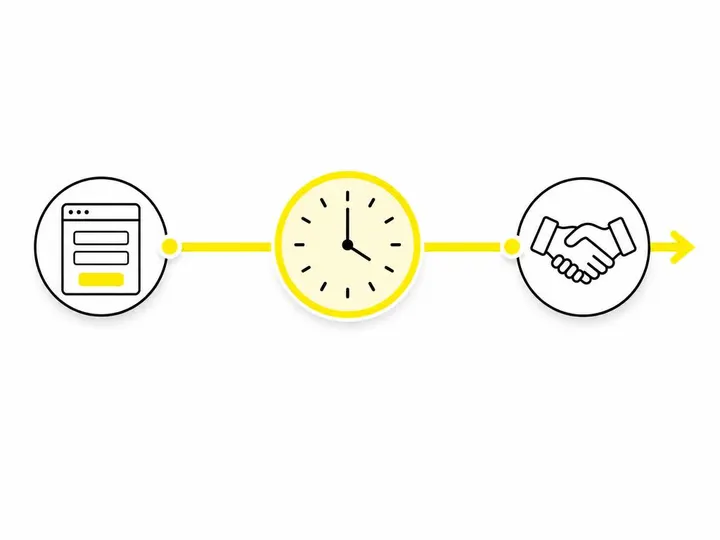
The ideal sequence: acknowledge within 5 minutes (automated is fine), then call or SMS within 60 minutes with a real person. If you can't do that, your business is too stretched. That's when you need using AI to respond to leads faster or a better system.
What Australian customers expect
Australian tradies and service businesses operate in a competitive market. Your customer has options. They expect you to call them back the same day, preferably within an hour. They expect you to know what they asked for (because you've read their form). They don't expect a script; they expect a conversation. Meet that expectation, and you'll stand out against 80% of your competitors who don't.
Step-by-Step: A Simple Website Lead Follow-Up Process
Here's a process any Australian business can implement today, even if you're working solo or with a small team.
Step 1 — Acknowledge immediately (within 5 minutes if automated)
Set up an automated email reply on your website form that says something like: "Thanks for getting in touch. We've received your enquiry and one of our team will call you by tomorrow morning." That's it. No long explanations, no marketing fluff. The goal is to confirm the message arrived and manage their expectation of when they'll hear from you.
If you're using a form on your website, most platforms (WordPress, Wix, Squarespace) let you set up an auto-reply in minutes. AI lead qualification for small business tools can even automate this acknowledgement with slightly more personalised wording if you want.
Step 2 — Call or SMS within the hour
This is where the real work starts. Within 60 minutes of that form submission, a real person from your team needs to call or text the prospect. Not an email. A phone call or SMS. This is the touchpoint that converts prospects into conversations.
Why? Because 64% of Australian consumers prefer SMS or WhatsApp for local service follow-up over email. A call is better if you can do it without sounding rushed. An SMS is faster if you're slammed. Either way, you're reaching them on the device they're holding right now.
Step 3 — Send a follow-up email within 24 hours
If they didn't answer the phone, send an email with the key details. Include your quote, your availability, a link to your Google Business Profile, and a clear next step. Make it easy for them to say yes. One paragraph. One call to action. Done.
Step 4 — Follow a 7-day touchpoint sequence
Don't give up after one call. A touchpoint sequence means you stay in contact at planned intervals: Day 1 (phone or SMS), Day 2 (email), Day 5 (another SMS or call), Day 7 (final email). That's four touches across a week. Research shows the average customer needs 5 to 8 touches before they decide, so you're in the ballpark. If they don't engage by day seven, move them to a nurture list (more on that below).
Step 5 — Mark leads as won, lost, or nurture
After your 7-day sequence, categorise every lead. Won means they booked or bought. Lost means they told you no or went elsewhere. Nurture means they're interested but not ready yet. Only nurture-list leads should get ongoing contact; you don't want to chase someone who's already said no.
How to qualify leads as a tradie is a skill worth learning, because it saves you time chasing bad prospects and lets you focus on warm leads.
Scripts You Can Use Right Now
SMS script for first contact
"Hi [Name], thanks for your enquiry about [service]. I'm [Your Name] from [Business]. I can [core benefit], usually around [timeframe]. Can you chat today? Reply yes or I'll call you around [time]."
Keep it short, friendly, and give them an easy out. You're not being pushy; you're confirming they want to talk.
Voicemail script when no one picks up
"Hi [Name], I'm [Your Name] from [Business]. I got your enquiry about [service] this morning. I've got availability this week and can help. Give me a call back on [number], or I'll try you again tomorrow morning."
Then actually call back the next morning. Consistency builds trust.
Follow-up email template
Subject: Re: Your [service] enquiry
"Hi [Name],
I couldn't reach you by phone, but I wanted to follow up on your enquiry.
[Two to three sentences about what you can do for them]
I can visit on [two specific dates/times]. Does either work? Reply here or call me on [number].
Cheers, [Your Name]"

Handing Leads Off Without Dropping the Ball
If you're working with staff or contractors, a missed handover kills the entire process. The lead comes in, but nobody knows whose job it is to follow up. Two days later, nobody's called, and the job's gone.
Setting up a centralised inbox or CRM
You need one place where all leads live. Not your personal email inbox, not a sticky note on the wall, not three different chat threads. One inbox, searchable, always current. For small businesses, this could be as simple as a shared email address that both you and your team can access. For anything more complex, a basic CRM (Customer Relationship Management system) like HubSpot or GoHighLevel is worth the cost.
A CRM lets you assign leads to team members, set reminders, track when calls were made, and see the full history of every conversation. That's what pipeline tracking means: you can see where each lead is in the process from first contact to closed job.
Assigning and tracking responsibility
When a lead comes in, assign it to someone immediately. Make it their job to call within the hour. Set a reminder. Track when they called, what was said, and what the next step is. If they don't follow up by the deadline, the lead escalates to you. That simple structure stops leads from falling through the cracks.
Automate your missed call follow-up if your team regularly misses calls. You can set up a system where missed calls automatically trigger an SMS or email, so no lead is ever unacknowledged.
Tools That Help Automate the Process
Simple options for tradies and small business owners
You don't need fancy software. Start with what you've got: a Google account (for shared calendar and contacts), a form tool (Gravity Forms, Typeform, or built into your website), and an email management system. Add an SMS tool like TwilioQuest or Sendinblue if you want to automate text reminders. These tools cost between AUD $20 to $100 per month.
Automate your quote follow-up by setting up email reminders that fire a few days after you've sent a quote, asking the customer if they have questions. Automation doesn't mean no personal touch; it means you never forget to follow up.
When to consider a CRM
If you're getting more than 20 leads per week, or if your team is bigger than two people, a CRM becomes essential. HubSpot (free tier available) and GoHighLevel are popular with Australian tradies. Both let you track leads, assign tasks, log calls, and generate reports on which marketing brings in the best leads. How to track where your leads are coming from is critical if you're spending money on advertising or SEO, because you need to know which channels actually work.
Common Mistakes That Kill Your Conversion Rate
You're doing everything else right great website, strong reviews, competitive pricing but your conversion rate is still low. These mistakes are usually why.
Waiting days to respond
The biggest killer. Waiting until "you get around to it" costs you jobs. Set a timer if you need to. Call back within 60 minutes or lose the lead. Period.
Sending one email and giving up
Email alone doesn't close deals. Call, text, or visit. Email is confirmation. If your first touchpoint is email and they don't reply, you've already lost momentum.
Not tracking where leads came from
If you don't know which marketing channel brought in a lead (website, Google Ads, Facebook, referral, Google Business Profile), you can't improve your marketing spend. Ask every lead: "How did you find us?" Log the answer. Over time, you'll see patterns. Some channels convert better than others. How to get more quote requests from your website makes sense only if you measure what's actually working.
Frequently Asked Questions
How quickly should an Australian business respond to a website enquiry?
Within one hour is ideal. At minimum, acknowledge the enquiry within five minutes (automated is fine) and make a real contact attempt within 24 hours.
What should the first follow-up message actually say?
Be direct and helpful. Say who you are, what they asked for, how you can help, and when they can expect to hear from you next. No jargon, no fluff.
How many times should you follow up before giving up on a lead?
Follow the 7-day touchpoint sequence (4 contacts across a week). If they're not interested by day seven, move them to a nurture list or let them go.
What is the best channel — phone, SMS, or email — for local service businesses?
Phone for hot leads (first 24 hours). SMS for follow-up (fast, non-intrusive, high open rate). Email for documentation and next steps. Use all three in sequence.
How do you hand a lead from a website form to a staff member without losing it?
Use a centralised inbox or CRM. Assign the lead to a specific person with a deadline. Track when they make contact and log the outcome.
What simple tools can a tradie or small business owner use to track and follow up leads?
Start with a shared email inbox and a Google Sheet. Graduate to HubSpot (free tier) or GoHighLevel if you're scaling. Add SMS tools like Sendinblue when you're ready to automate text follow-ups. SMS text-back when you miss a call is a simple feature that keeps leads warm even when you're unavailable.
Conclusion
Following up website leads isn't complicated. It's a system: receive, acknowledge, contact, sequence, track, and qualify. Most Australian businesses fail at it not because they don't know how, but because they don't have a process. They wing it, hope for the best, and wonder why their conversion rate is poor.
The businesses that win are the ones that respond fast, stay organised, and follow through consistently. You don't need to be the biggest or the fanciest. You just need to call back within an hour when your competitor takes two days. That speed gives you the edge.
Pick one thing from this article and implement it this week. Set up an automated acknowledgement email. Create a simple SMS script. Assign a follow-up deadline to your team. Then measure the results. You'll see the difference in your conversion rate within a month.