Medical Clinic SEO: How to Get More Online Bookings from Google Search
On this page 8 sections
Key takeaways
- Optimise your Google Business Profile as a booking asset, not just a directory listing
- Build genuine service-and-suburb pages with clinician details, fees and a clear booking action
- Measure booked appointments, not just rankings or traffic, using GA4 and Search Console
- Healthcare pages need named clinicians, qualifications and review dates to earn Google trust
- Local and service-specific searches drive booking intent far more than broad informational queries
Google Search remains the leading alternative source of healthcare information for Australian patients, with 21% turning to Google when they need to find a clinic, understand a condition or book an appointment. But search visibility alone doesn't fill your books. Medical clinic SEO that works is built backwards from the booking moment, starting with the searches patients actually perform when they're ready to choose a provider.
Why Google Is Still Your Clinic's Most Important Referral Source
Google Search drives more patient discovery than AI chat tools, healthcare websites or phone directories combined, according to the 2026 Australian Healthcare Index. That matters because it means your clinic's visibility in local search results, appointment scheduling and service-and-suburb pages is not a convenience, it's your primary patient acquisition channel.
What the 2026 Australian Healthcare Index tells us
Researchers surveyed 6,244 Australians in June 2026 and found that 21% used Google Search as their leading alternative source of healthcare information. AI chat tools came third at 11%. The findings, reported by Medical Republic, highlight that despite the rise of AI-powered discovery, search remains the dominant patient pathway for GPs, allied health practitioners, specialists and walk-in clinics.
This means your clinic needs both discoverable educational content and direct-to-booking pages optimised for the moment when a patient is actively looking for your services. Clinics that rank for branded searches ("Dr Jane Smith clinic"), service-and-location searches ("physio in [suburb]") and condition searches ("sports injury treatment Melbourne") win the most bookings.
How AI Overviews are changing health searches
Google AI Overviews appeared in roughly half of health searches in 2025 research. These AI-generated summaries can answer informational queries directly within Google, reducing clicks to clinic websites. However, local searches ("GP near me"), branded searches ("Westside Medical Centre") and service-specific searches ("video consultation available") are significantly less likely to show AI Overviews, meaning patients still need to visit your website or Google Business Profile to book.
Your clinic's strategy should be to prepare for AI-powered search while prioritising local service pages because they remain closer to booking intent. That means structuring answers clearly on condition pages, citing reliable sources, and ensuring your local SEO foundation is strong.
Start With the Right SEO Goal: Bookings, Not Rankings
Medical clinic SEO should be measured against booked appointments, not search rankings or organic traffic volume. A clinic can rank number one for "dentist in Sydney" and still have zero appointments if visitors can't navigate to the booking page or the booking form is broken.
The funnel to measure: from search impression to booked appointment
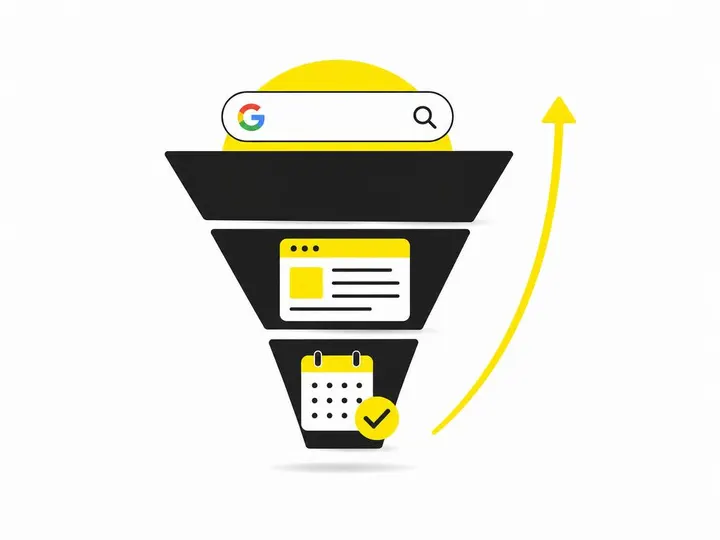
Your conversion funnel has several stages. A patient searches ("emergency dentist open now"), clicks your result, lands on your clinic website, finds the appointment page, selects a time and completes the booking. Each stage can leak: searchers click a competitor instead, your page doesn't load on mobile, appointment links are broken, or the booking system is confusing.
Measure the entire journey. Track:
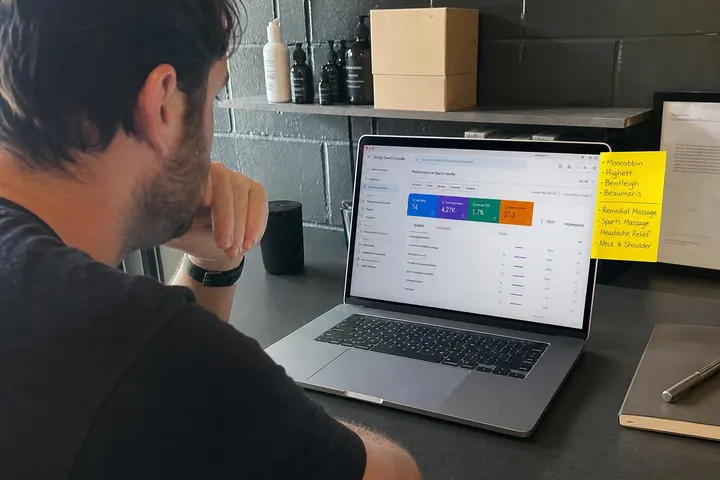
Google Search Console: impressions, clicks, average position and conversion events by service or location.
GA4 events: "viewed_booking_page", "started_booking", "completed_booking" and phone calls tracked via call extensions or call-tracking numbers.
Practice-management system data: which traffic source, keyword or landing page led to each booked appointment and new-patient revenue.
This reveals where your funnel actually leaks. You may have strong rankings but poor booking rates, or low traffic but high conversion, which tells you whether to invest in visibility or conversion rate improvement.
Setting up GA4 and Search Console for clinic conversions
Start by monitoring your clinic in Search Console to see which queries drive clicks. Filter by service (e.g., "physiotherapy", "telehealth", "bulk-bill GP") and location to identify your strongest local searches. Then set up GA4 conversion events for each booking stage and connect Search Console to GA4 so you can see which queries actually lead to completed bookings.
Link your practice-management system to GA4 if possible, so a booked appointment triggers a conversion event. This closes the loop and tells you which keywords, pages and traffic sources are genuinely valuable to your clinic's bottom line.
Optimise Your Google Business Profile as a Booking Asset
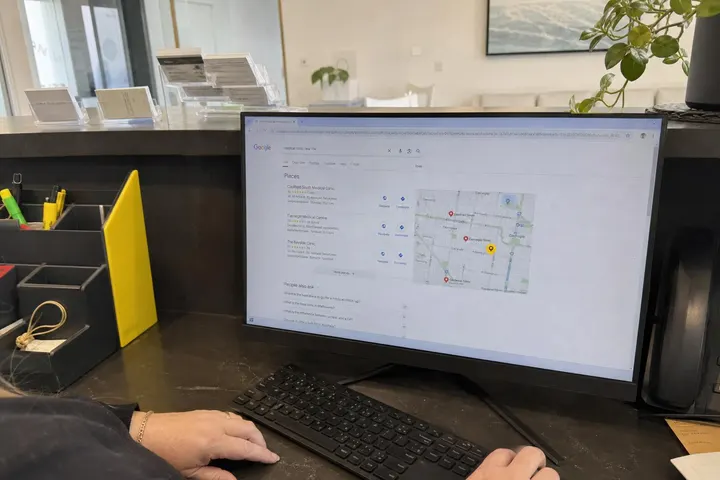
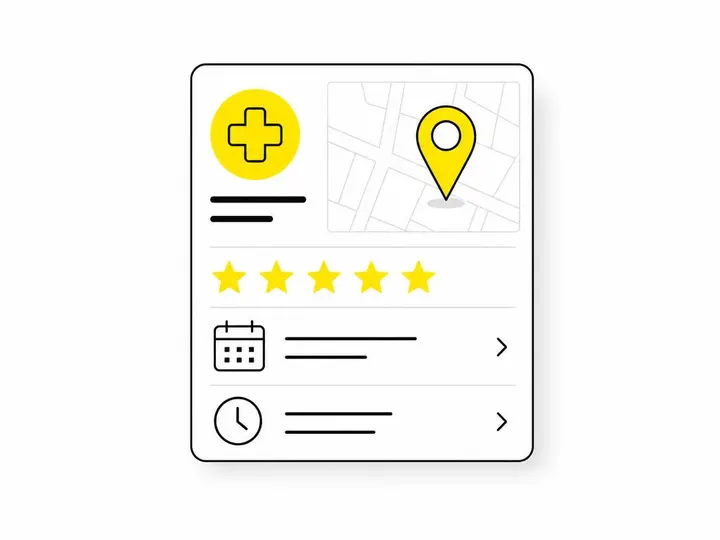
Your Google Business Profile is not a directory listing it's a clinic landing page inside Google Search and Maps. Every field, photo, link and review either moves a patient toward booking or away from it.
Categories, services and appointment links
Start with choosing the right Google Business Profile category. If you're a GP clinic, select "General Practitioner" or "Clinic". If you're a physio, choose "Physiotherapy Clinic" or "Sports Medicine Clinic". Incorrect categories reduce your visibility in relevant searches.
Add all services you offer telehealth appointments, bulk-bill GP consultations, allied health, home visits, urgent same-day slots. When a patient searches "telehealth doctor" or "bulk-bill physiotherapist", Google matches their query to your profile's listed services. Missing or outdated services mean missing bookings.
Link directly to your online booking system or appointment page. If Google users have to navigate your website to find the booking form, conversion drops sharply. Test your profile on mobile to ensure the appointment link is visible above the fold and works instantly.
Opening hours, photos and the review strategy
Incorrect opening hours are a hidden booking killer. If your profile says you're open but you're actually closed for lunch or public holidays, patients waste time and lose trust. Update your hours in real time and use Google's appointment-availability feature if available.
Photos humanise your clinic. Include your waiting room, consultation space, clinicians and reception staff. Photos of clinicians with their name and qualifications visible build trust and help patients know who they're booking with. Ensure photos are recent and high quality.
Reviews directly affect ranking and conversion. Getting more leads from Google reviews starts with asking patients to review after their appointment. Respond to all reviews, especially negative ones, with professionalism and empathy. Google's algorithm and potential patients both notice clinics that engage with feedback.
AI-powered messaging: what clinics need to know
Google is testing AI-powered messaging for some Business Profiles, allowing patients to send questions directly within the profile. If this feature appears on your profile, monitor and respond promptly. However, never provide individualised medical advice via messaging use it to answer operational questions ("Do you offer telehealth?", "What's your car parking like?") and direct patients to book a consultation for clinical advice.
Build Service-and-Suburb Pages That Win Local Searches
A patient searching "GP in Parramatta" or "paediatrician bulk-bill western suburbs" needs a page that answers their query directly with clinic location, clinicians, services available at that site, accessibility, fees and a booking link. Generic homepage content doesn't rank, and thin pages that differ only by suburb don't rank either.
What a genuinely useful clinic location page includes
Create location pages only for clinics where you genuinely have different clinicians, services, fees or availability. A page for each suburb is thin content; a page for each suburb *and clinic branch* is usually justified. Include:
The specific clinicians working at that location, with qualifications and photo if possible.
Services available at that branch (some clinics don't offer all services at all locations).
Opening hours, holiday closures and urgent-access options.
Fees or bulk-bill status; if fees vary by service or clinician, state that clearly.
Appointment types: in-person, telehealth, same-day urgent, bulk-bill, private.
Accessibility: parking, wheelchair access, public transport, facilities for children or elderly patients.
A direct link to your online booking system filtered for that location.
Use schema markup for local businesses so Google understands your clinic's address, phone, hours, clinicians and services. Structured data helps Google rank your pages accurately and show key details directly in search results.
Create Clinically Trustworthy Content Google Will Rank
Google treats medical content as "Your Money or Your Life" (YMYL) high-stakes information that affects health decisions. Pages must demonstrate Experience, Expertise, Authoritativeness and Trust, known as E-E-A-T. This is not optional for healthcare SEO.
E-E-A-T for healthcare: what it means in practice
Experience means the page should be written or reviewed by someone with direct experience in that area—a clinician, not a marketing writer. Expertise means verifiable qualifications, training and clinical knowledge. Authoritativeness means the clinician or organisation has earned recognition in their field. Trust means reliable citations, transparent sources and accurate practice information.
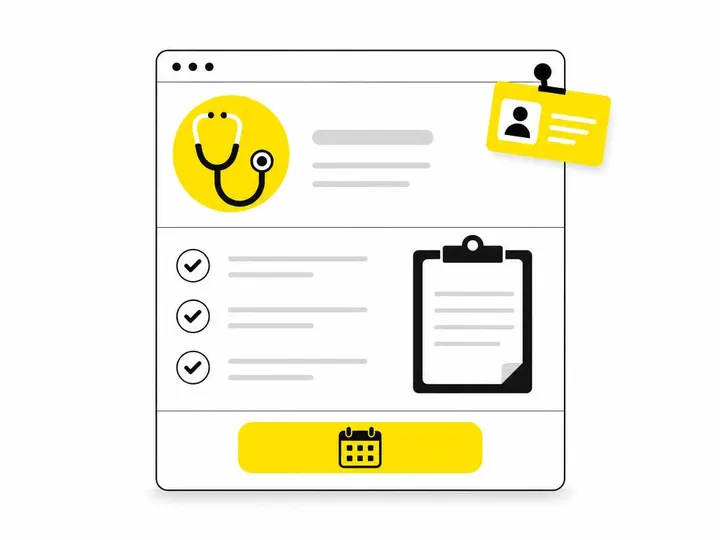
In practice, that means every condition or treatment page should carry the reviewing clinician's name, full qualifications, registration number (if relevant), review date and reliable references. If your clinic's physio writes a page on "ACL injury recovery", their name, qualification in sports physiotherapy and credentials should be visible. If a page is AI-generated, it must be clinically reviewed and the reviewer named.
Avoid unsupported claims ("Our treatment has a 95% success rate"), exaggerated outcomes ("Guaranteed pain relief") or unreviewed AI-written medical copy. AHPRA advertising guidelines for health practitioners set strict limits on what you can claim, and Google's ranking systems penalise medical pages that break those rules.
Condition and treatment pages done right
A page on "tension headaches" should explain the condition clearly, describe your clinic's approach and evidence-based treatments, name the clinician who reviewed it, cite reputable sources (Mayo Clinic, government health departments, peer-reviewed journals), and end with a clear call to book a consultation. A patient who reads that page learns something useful and knows exactly how to take the next step.
Keep pages updated. If your clinic's treatment protocols change, update the page and review date. Google ranks fresh, clinically current content higher than outdated pages.
Design the Search-Result-to-Booking Journey
Search intent and page content must match. A patient searching "sharp pain in my knee" needs a concise, clinically reviewed explanation and a clear next step not a sales pitch. A patient searching "physiotherapy bulk-bill Eastwood" needs availability and booking, not a long educational article.
Matching page content to patient intent
Categorise your pages by search intent. Informational searches ("What is a stress fracture?") need clear explanations. Local searches ("Physio near me") need location, services and booking. Branded searches ("Dr Sarah Chen clinic") need clinician info and booking. Service-specific searches ("telehealth psychiatrist") need proof you offer that service and a direct booking link.
Match page length and depth to intent. Informational pages can be 1,500 to 2,500 words. Service-and-location pages should be concise (500 to 800 words) and action-focused. A patient ready to book doesn't want to scroll through a long article.
Making the booking action impossible to miss
Your booking link or button should be visible above the fold, repeated at the end, and prominent enough to catch attention without being garish. Use plain language: "Book a consultation", "Schedule your appointment" or "Get a time". Avoid vague buttons like "Learn More" or "Contact Us" on pages where booking is the goal.
Test your booking flow on mobile. If your clinic's online booking system is slow, asks too many questions upfront or requires account creation before showing availability, patients abandon it. Turning website visitors into patients starts with removing friction from the booking process.
Tracking, Core Updates and Staying the Course
Google rolled out a core algorithm update starting 10 November 2026, expected to take up to two weeks to complete globally. How you respond depends on your data, not your rankings alone.
Using the November 2026 core update as a measurement checkpoint
Record your clinic's search rankings, impressions, clicks and completed bookings in the week before 10 November. After the rollout completes (around 24 November), compare your data to the baseline. Did clicks drop for a specific service or location? Did conversion rate change? Are your best-performing keywords affected?
Use Search Console to filter results by location, service, query and device. A clinic in Sydney might see a small rankings shift that has no impact on bookings, while a clinic in a smaller area might see a larger change. Measure the impact on actual bookings, not just rankings.
What to do when rankings shift
Avoid overreacting. Don't rewrite your entire website because one page dropped five positions. Instead, assess whether your most valuable pages the ones that drive bookings were affected. If they were, investigate why. Did you miss a clinician name on a page? Is your E-E-A-T signal weak? Are reviews outdated?
If your clinic needs a comprehensive evaluation, start with an SEO audit to identify technical issues, content gaps, booking funnel friction and local search optimisation opportunities. SEO built for medical clinics requires healthcare expertise, local knowledge and conversion focus not just keyword rankings.
The goal of SEO is not to rank for a keyword; it's to book patients who search for your services. Measure, analyse and improve by that standard.
Conclusion
Medical clinic SEO in 2026 is built backwards from the booking moment. Your clinic's visibility in Google Search matters because 21% of Australians start their health journey there. But visibility means nothing without a clear path from search result to booked appointment. That path includes a strong Google Business Profile with working appointment links, service-and-location pages that describe your clinic accurately and completely, clinically trustworthy content written or reviewed by named clinicians, and a booking process so simple that a patient can complete it in seconds on their phone.
Use GA4 and Search Console to measure the entire funnel: impressions, clicks, booking-page visits and completed bookings. Track by service, location and query so you know which searches drive real value to your clinic. Record your baseline now, assess the impact of the November 2026 core update when it completes, and focus on the pages and searches that actually book patients.
Medical clinic SEO is not about dominating Google; it's about being findable by the right patients at the right moment, and making it effortless for them to become your next appointment.