Cosmetic Skin Clinic Landing Page: What Prospective Patients Need to See Before Booking

On this page 8 sections
Key takeaways
- Put the practitioner's name, registration and qualifications near the top of the page
- Explain the treatment process, downtime and common risks before the booking form
- Use 'Book a consultation' not 'Buy now' AHPRA requires a consultation-led journey
- Avoid testimonials: AHPRA prohibits them in regulated health service advertising
- Create separate landing pages for injectable, laser and skin treatment categories
- Audit your ads, booking form and landing page to keep claims consistent across channels
Your cosmetic skin clinic landing page has one job: help the right patients decide to book a consultation with confidence. But it also has a second job that most clinics ignore until it costs them. Every word, every claim and every design choice has to comply with AHPRA and TGA advertising rules, or you risk enforcement action, fines up to $1.65 million per breach, and damage to your clinic's reputation. The landing page that converts bookings is also the landing page that keeps your clinic out of the regulator's audit file.
Why your landing page is a compliance and conversion problem at the same time
A cosmetic clinic landing page has to walk a narrow line between persuasion and regulation. You need to attract patients, answer their questions and prompt them to book. But you cannot use testimonials, make dramatic promises, hide risk information or encourage unnecessary treatment. Those rules are not suggestions. AHPRA assessed advertising for 34 practitioners and health services in its proactive cosmetic surgery advertising audit published in October 2026, and it is continuing to strengthen regulation of practitioners who perform and advertise non-surgical cosmetic procedures.
AHPRA and TGA advertising rules that affect every cosmetic clinic page
AHPRA's advertising guidelines for regulated health services require that claims be accurate, not misleading and supported by acceptable evidence. The National Boards updated non-surgical cosmetic advertising guidance in September 2025, and those rules now shape what you can and cannot say on your landing page. If you are advertising cosmetic injectables, the TGA's updated guidance from November 2025 adds another layer of control, particularly around prescription-only products. Cosmetic injectables are an enforcement priority for 2026 and 2027, and the penalties are real: up to $1.65 million per individual breach.
The specific restrictions that affect your landing page include a ban on patient testimonials or purported testimonials, a requirement to avoid creating unreasonable expectations of treatment outcomes, a ban on encouraging unnecessary use of services, and strict rules around any discounts or inducements. These are not abstract compliance issues. They shape whether your page converts bookings honestly or gets flagged during an audit.
What happens when the page is non-compliant or unconvincing
A non-compliant landing page can trigger AHPRA investigation, complaints from patients who felt misled, and suspension of your ability to advertise. A page that is legally safe but poorly designed will also fail: patients will leave without booking because they do not understand who is treating them, what happens during treatment, or whether the treatment is right for them. The best landing page does both at once. It builds trust through transparency, answers the questions patients actually ask, and guides them toward a consultation without crossing the line into prohibited claims or misleading language.
Lead with who is treating the patient, not what you are selling
Patients choosing a cosmetic clinic are choosing a practitioner first and a treatment second. Your landing page should put the practitioner's credentials, registration and experience near the top, not bury them below treatment hype. This is both a compliance requirement and a conversion tactic.
The practitioner information that belongs on your page includes full name, registered profession (e.g. registered nurse, doctor, cosmetic technician), relevant qualifications, years of experience in cosmetic practice, areas of specific practice, and verification of current AHPRA or professional registration. If the practitioner has completed additional training or holds credentials in relevant specialisations, include those. Use plain language: "Dr Sarah Chen is a registered medical practitioner with 12 years of experience in aesthetic medicine and holds a Diploma in Aesthetic Nursing." That is credible. "Leading expert in cosmetic injectables" is not, unless it can be backed by an award or published qualification.
Avoid vague claims such as "expert", "leading", "best" or "gold standard" unless you can point to specific, verifiable evidence: a professional award, published research, a relevant qualification recognised by the National Boards, or measurable experience. If you cannot substantiate it, do not write it. That simple rule keeps your page compliant and makes it more convincing to patients who are comparing clinics.

Explain the treatment before you ask for the booking
Patients need to understand what a treatment involves, what they should expect, and what can go wrong before they commit to a consultation. Explaining the treatment upfront builds informed decision-making and protects both the patient and your clinic. This is where your landing page becomes a tool for patient education, not just a sales funnel.
The treatment information that patients need includes who the treatment may suit and who it is not suitable for, what happens during a consultation (is it in-person, video, or both?), what happens during the treatment itself, typical downtime and when normal activities can resume, common risks and less common risks (and how they are managed), expected timeframe for results and how long results typically last, maintenance or top-up requirements, and when or why results vary between patients. Use plain language rather than medical jargon. Explain downtime clearly: "You may experience redness and slight swelling for 1 to 2 hours after treatment, which usually resolves by the next day." That is honest and practical.
Risk information should be easy to find and easy to understand. Do not bury it in small print at the bottom of the page or behind a link that patients have to hunt for. AHPRA's guidance requires risk information for higher-risk non-surgical cosmetic procedures, and that means you need to display it prominently without scaring away genuine prospects. A dedicated "Risks and Benefits" or "What to Expect" section near the top or middle of the page is a compliance choice that also serves your patients better.
Make the consultation the primary call to action
Your landing page should guide patients toward booking a consultation, not toward booking a treatment directly. A consultation-led booking journey is now required for cosmetic injectables under current TGA guidance, which mandates a real-time, in-person or video consultation with the prescribing practitioner before treatment. Your call to action should reflect that.
Compliant CTA wording for cosmetic clinics includes "Book a consultation", "Request an assessment", "Discuss your options" or "Schedule your consultation". Avoid wording such as "Book now" without context, "Get your treatment" or any language that implies the patient can skip the assessment step. Make it clear in or near the CTA button whether the consultation is with the prescribing practitioner, whether it is in-person or by video, and how long it typically takes.
On the question of pricing, the research and practice vary. If you show pricing, show ranges if price varies by individual patient need, and always link to a "Consultation fees" section that explains whether the consultation itself is charged, how much, and whether that fee is deducted from the cost of treatment. If you offer a discount or inducement, include the conditions clearly and prominently: expiry date, exclusions, whether it applies to consultation fees, and any other relevant terms. Do not hide the terms in fine print. AHPRA rules require that inducements include clear conditions, and that requirement protects you as much as it protects patients.

What to use instead of testimonials
Patient testimonials, reviews and purported testimonials are prohibited on regulated health service advertising pages under AHPRA rules. That means no "5-star reviews", no patient quotes, no before-and-after photos with patient commentary, and no case studies attributed to named patients. Many clinics break this rule without realising it, and it is an easy audit flag.
The trust signals that do work for a cosmetic clinic landing page include practitioner credentials and registration status (verified against the AHPRA Register or relevant National Board), healthcare website design that looks professional and secure, published clinical information and educational content that answer common questions, clear eligibility criteria and realistic descriptions of outcomes, evidence-based claims backed by published research where relevant, and accurate, easy-to-find information about consultation and cancellation terms. You can also use before-and-after imagery if it complies with AHPRA guidelines (generic, not attributed to a named patient, and not presented with claims beyond what the image itself shows).
If you have a strong online reputation or have been featured in mainstream media, you can reference that on your landing page: "Featured in The Sydney Morning Herald" or "5-star rating on Google with 200+ patient reviews" (the rating itself is not a testimonial; it is an aggregate metric). But do not link to or reproduce individual patient comments.
Build separate landing pages by treatment category
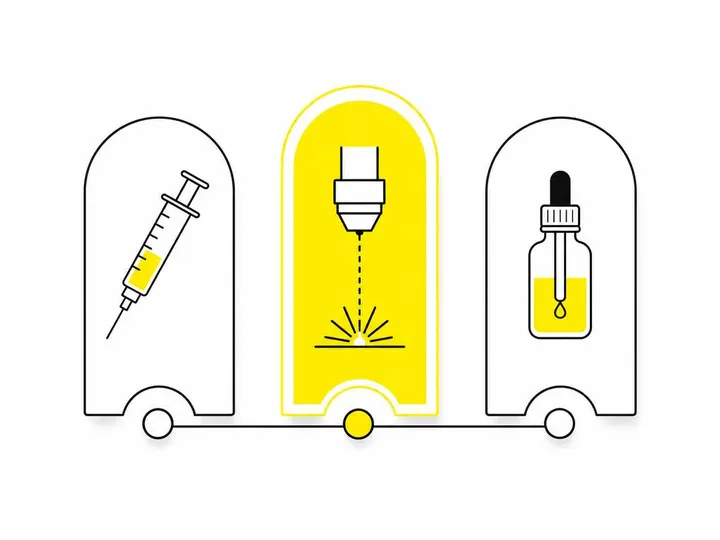
One generic landing page for all cosmetic treatments works against you in three ways: it dilutes your message, it forces you to compromise on treatment-specific information, and it makes compliance harder because different treatments carry different risks and advertising restrictions. A dedicated landing page for injectables, a separate page for laser treatments, and a third page for skin treatments gives each category the space and specificity it needs.
Cosmetic injectables (such as anti-wrinkle injectables or dermal fillers) are prescription-only products under TGA regulation and carry specific consultation and prescribing requirements. Laser treatments involve different equipment, training, risks and downtime than injectables. Skin treatments (chemical peels, microneedling, skincare) have a different regulatory profile again. Each category needs its own landing page because each answers different patient questions. A patient researching anti-wrinkle injectables does not need to read about your laser capabilities on the same page. A targeted page with treatment-specific information, risks and credentials also ranks better in search results for that specific treatment.
When you build separate pages, ensure that your cosmetic clinic SEO strategy includes a clear information architecture, so patients can navigate from one treatment page to another and find what they need without friction.
Audit the full booking journey, not just the page
Your landing page is one asset in a larger ecosystem. Every claim on the landing page also appears in your Google Ads copy, your Meta ads, your social media posts, your follow-up emails and your booking confirmation. If those claims are inconsistent, you create confusion and give auditors multiple points to flag. AHPRA's active auditing and the TGA's injectable enforcement focus make cross-channel consistency urgent.
Start by mapping every claim on your landing page. If the page says "Consultation with Dr Sarah Chen", your Google Ads should say the same. If the page says "Results typically appear after 2 weeks", your email follow-up should not promise results in 5 days. If the landing page displays prominent risk information, your social media ads should not minimise or contradict those risks. If you offer a discount, every promotional channel should show the same terms.
Review your landing page against the AHPRA advertising guidelines and the AHPRA advertising resources for regulated health services. Then review your ads, your booking form, your email templates, your social media copy and your follow-up sequence with the same lens. Consistency across these channels is not just good practice; it is a compliance requirement.
Conclusion
A cosmetic skin clinic landing page that converts bookings and passes compliance audit is not built by accident. It starts with clear, verifiable information about who is treating the patient, what the treatment involves, and what realistic outcomes look like. It uses compliant language, makes risk information easy to find, and guides patients toward a consultation rather than an impulse booking. It avoids testimonials, vague claims and hidden terms, and it stays consistent across every promotional and booking touchpoint.
The clinics that win more consultations are the ones that treat their landing page as an educational tool first and a sales tool second. Patients choose cosmetic clinics based on trust, and trust comes from transparency: clear credentials, honest explanations, visible risk information and straightforward terms. That approach also keeps your clinic out of the regulator's audit file, which is the foundation everything else is built on.
Start by auditing your current landing page against the AHPRA guidelines. If you are building one from scratch, begin with practitioner credentials and treatment information before you think about design. Test your conversion rate optimisation by tracking not just bookings but also which elements patients spend time reading, and adjust based on that data. Your landing page is your clinic's most important marketing asset. Make it count.