How to Calculate Cost Per Booked Job for Your Marketing

On this page 7 sections
Key takeaways
- Divide total spend by booked jobs, not raw leads
- Track every lead source or your numbers will be wrong
- A cheaper lead that never books is worse than an expensive one that does
- Compare cost per booked job across channels monthly
- Know your average job value to set a sensible maximum CPBJ
Most Australian tradies and service business owners measure marketing success using the wrong numbers. They obsess over cost per click or cost per lead, then wonder why their marketing spend isn't converting into actual booked jobs. Cost Per Booked Job (CPBJ) is the metric that actually matters, and it's the only way to compare whether your Meta Ads, Google Local Services, or organic efforts are genuinely worth the money you're spending.
Why Cost Per Click and Cost Per Lead Miss the Point
Cost Per Click (CPC) and Cost Per Lead (CPL) tell you how cheaply you can attract attention, but they tell you nothing about whether that attention turns into work you can actually bill for.
The difference between a lead and a booked job
A lead is someone who's enquired. A booked job is a confirmed appointment or contract where you're getting paid. These are fundamentally different outcomes. You might generate 50 leads for $1,000 in ad spend (a $20 CPL that looks great on paper), but if only 2 of those leads book jobs, you've actually spent $500 per booked job. That's very different from the $20 you thought you were paying.
The gap between a lead and a booking depends on your lead-to-booking rate. For tradies, this varies wildly. A plumber with a strong follow-up system might convert 30 to 40 percent of enquiries. A landscaper with spotty phone habits might convert 5 to 10 percent. If you don't know your own conversion rate, you're flying blind.
What happens when you optimise for the wrong metric
When you chase low CPC or CPL, you often end up attracting the wrong people. You might optimise your Meta Ads for maximum reach, generating cheap clicks from people nowhere near your service area. Or you might target such broad keywords on Google that you're attracting window shoppers instead of people ready to book. Your cost per lead goes down, but your cost per booked job goes through the roof because you're wasting time on unqualified enquiries. That's why how to qualify leads as a tradie matters far more than raw volume.
The Cost Per Booked Job Formula (And How to Run the Numbers)
The formula for Cost Per Booked Job is straightforward, but getting accurate numbers requires discipline and a system for tracking where every booking actually came from.
The basic formula
Cost Per Booked Job equals total marketing spend divided by the number of booked jobs that came from that channel:
CPBJ = Total Marketing Spend / Number of Booked Jobs
The challenge is that middle number. You need to know exactly how many of your booked jobs came from paid ads, Google Local Services, organic search, word of mouth, or other sources. This requires consistent tracking from the moment an enquiry arrives.
A worked example for a tradie business
Let's say you're a Brisbane electrician running ads on both Meta and Google Local Services.
Meta Ads spend: $1,500 per month
Enquiries from Meta: 35
Booked jobs from Meta: 7 (20% conversion)
CPBJ from Meta: $1,500 ÷ 7 = $214 per booked job
Google Local Services spend: $1,200 per month
Enquiries from Google: 28
Booked jobs from Google: 8 (29% conversion)
CPBJ from Google: $1,200 ÷ 8 = $150 per booked job
In this case, Google is outperforming Meta on a cost-per-booking basis, even though you're spending more on Meta. This is exactly the comparison that matters. For more detail on this comparison, see comparing Google and Facebook ads for tradies.
How to set a maximum acceptable CPBJ
Your maximum acceptable CPBJ should be based on your average job value and profit margin. If your average job is worth $2,000 and your profit margin is 35 percent, your profit per job is $700. You could spend up to $350 per booking and still make $350 profit, though in practice you'd want a buffer. A reasonable rule of thumb is that your CPBJ shouldn't exceed 15 to 20 percent of your average job value. This keeps your marketing sustainable as you grow.
How to Track the Data You Actually Need
The numbers only work if you're capturing where each lead actually comes from and following it through to a booked job.
Capturing lead source at the enquiry stage
Every time someone enquires, you need to know which channel they came from. Use UTM parameters on all your ad links so each click carries a tag. For example, a Meta ad link might be: `website.com.au/contact?utm_source=meta&utm_medium=cpc&utm_campaign=june2026`. When someone fills out your form, that data should log automatically.
For phone enquiries, ask "How did you find us?" and record it in your system. For Google Local Services leads, the platform labels them automatically. The key is consistency: every single enquiry needs a source tagged before you follow it up.
Following the lead through to a confirmed booking
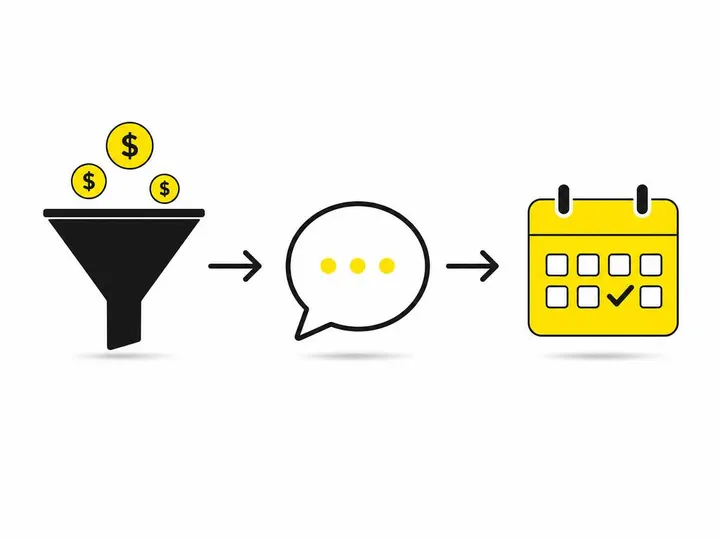
You need to track what happens to each lead. Did they get a quote? Did they go silent? Did they book? When? Use a simple system to move each lead through stages: Enquiry > Quoted > Booked > Completed. A basic spreadsheet works, but a CRM tool for Australian tradies makes this much easier to scale. You need to know not just how many leads came in, but how many actually turned into jobs you got paid for.
Simple tools that make this manageable
You don't need an expensive CRM. Google Forms can capture lead source. A simple Google Sheet can track leads from enquiry to booking. Converting website leads into booked jobs requires a system, but it doesn't have to be complex. The goal is consistency and speed: every lead tagged at source, every lead followed up within 24 hours, every booking logged against its source channel.
Comparing Channels Using Cost Per Booked Job
Once you have CPBJ data for each channel, you can make genuine business decisions about where to invest your budget.
Meta Ads vs Google Ads vs organic: a fair comparison
Meta Ads and running Meta Ads as a local tradie usually attract people early in their search journey, so conversion rates are often lower but reach is wider. Google Local Services attracts people actively searching for your service right now, so conversion rates tend to be higher but volume may be lower. Organic traffic from your website is free on a per-click basis, but it takes months to build. Calculate CPBJ for each honestly, and you'll see which deserves more budget.
Why lead quality differs between channels
A lead from Google Local Services where someone actively searched for an electrician is usually more qualified than a lead from Meta where someone was shown an ad in their feed. This often shows up in conversion rates and job value. You might have a lower CPBJ on Google because your closing rate is higher, not because the channel is cheaper on a per-click basis. Understanding this prevents you from cutting off good channels just because their CPC looks high.
When a higher CPBJ is still worth it
Sometimes a channel with a higher CPBJ is worth maintaining because the jobs are bigger, the customer quality is better, or the repeat booking rate is higher. Track not just CPBJ, but also average job value and customer lifetime value by channel. A $300 CPBJ might be worth it if jobs from that channel average $4,000 and those customers rebook. A $150 CPBJ might be a waste if jobs are $1,200 and one-off.
Common Mistakes That Wreck Your Numbers
Three mistakes kill CPBJ tracking for most small businesses.
Not tracking lead source consistently
If half your leads are tagged and half aren't, your numbers are useless. You end up miscalculating which channels work. Fix this: make lead source a mandatory field on every online form, ask on every phone call, and log it the same way every time. Tracking lead sources as a tradie only works if it's automatic and non-negotiable.
Counting unqualified enquiries as booked jobs
An enquiry from someone outside your service area, or someone who can't afford you, isn't a booked job. Counting it inflates your conversion rate and makes your CPBJ look better than it is. Only count an actual booking where you've agreed on a job, price, and date. This is where qualification happens: filtering out tyre-kickers before they waste your time improves both your CPBJ and your efficiency.
Ignoring seasonality
CPBJ will vary month to month based on seasonality. Winter demand for heating is different from summer demand for air conditioning. Don't panic if one month looks bad. Calculate your CPBJ quarterly or annually to see the real trend. But do track monthly to spot if one channel stops performing mid-season.
Putting It Into Practice: A Simple Monthly Review
You don't need complex software to start. A basic spreadsheet is enough to change how you make marketing decisions.
A basic tracking spreadsheet setup
Create a sheet with these columns: Date, Lead Name, Lead Source (Meta / Google / Organic / Referral), Phone/Email, Quoted (Y/N), Quote Amount, Booked (Y/N), Job Date, Job Value. At the end of each month, count booked jobs by source and divide total spend by that number. That's your CPBJ. You can then decide how to adjust your budget. For more strategic thinking on budget allocation, see working out how much to spend on marketing based on actual CPBJ data.
What to do when one channel underperforms
If Meta suddenly has a CPBJ of $400 when it was $200 last month, something changed. Pause and investigate: Did you change your targeting? Did the audience get worse? Are you receiving fewer enquiries or worse quality enquiries? Sometimes a channel needs optimisation, not abandonment. Sometimes it's seasonal. Give it 30 to 60 days of data before killing it. But if a channel stays expensive for a quarter, reallocate that budget to what's working.
Conclusion
Cost Per Booked Job is the only marketing metric that matters for a tradie or service business. It cuts through the noise of clicks and impressions and tells you the actual cost of acquiring the work you get paid for. Most Australian small business owners never calculate it, which is why they're often pouring money into channels that don't work and cutting channels that do.
Start tracking today. Tag every enquiry with its source, follow it to a booking, and calculate your CPBJ monthly. You'll quickly see which channels earn their keep. Within three months you'll have enough data to make smarter budget decisions. Within six months you'll be outspending competitors who are still guessing. The maths is simple; the discipline is what separates businesses that grow from those that spin their wheels.
Track your CPBJ, adjust your spend based on real numbers, and your marketing will stop being an expense and start being an investment.