Construction Marketing: How Australian Builders Win Better Jobs Online in 2027
On this page 8 sections
Key takeaways
- Market specific build types, not just 'builder' granny flat and house-and-land searches have very different demand
- Only 10% of builder ads link to a dedicated landing page fixing this alone lifts conversion
- Your landing page headline must name the exact build type and suburb to convert
- Meta works best as a pre-qualification tool, not a cheap-lead generator
- Publish project proof as text, not just images, for SEO and AI-mediated search
- Qualifying enquiry forms save more money than they cost you in missed leads
Most builders don't need more enquiries. They need better ones: clients with a real site, a realistic budget and a build type you actually want to deliver. Good construction marketing in 2027 is less about being everywhere and more about matching each channel to the job you want. That starts with SEO for construction companies built around specific project types, not a generic "we build homes" message.
Why Does Most Builder Marketing Produce the Wrong Jobs?
Most builder marketing attracts the wrong jobs because it targets "builders" broadly instead of the specific build types, budgets and locations the business wants. A website that says "quality homes, renovations and extensions across Sydney" speaks to everyone and convinces no one.
Broad targeting attracts tyre-kickers, not ideal clients
When your ads and pages chase generic terms, you pay for people still dreaming, people without land, and people wanting a $40,000 bathroom when you only take on $600,000 custom homes. Every one of those calls costs you time on site visits and quotes that never convert.
What the 2026 search data actually shows about build-type demand
The Uprise Digital 249-site builder website audit (October 2026) analysed Google search data from September 2025 to August 2026 and found demand moving in very different directions by build type:
Granny flat builders: 2,450 average monthly Australian searches, up 147% year on year
House and land packages: 11,183 average monthly searches, up 4%, peaking at 14,800 in September 2025 and dropping to 8,100 in June 2026
Home builders: down 20%
Renovation builders: down 47%
Treat these as directional industry figures rather than official market statistics. The message is still clear: broad "builder" terms are softening while specific project types are holding or growing.
Channel 1, SEO: Rank for the Build Types You Actually Want
SEO produces the best long-term lead quality for builders when each page targets one build type in one area. Someone searching "knockdown rebuild Hills District" knows exactly what they want, and that intent is worth far more than a vague homepage visit.
Create separate pages for each project type
Give granny flats, duplexes, knockdown rebuilds, extensions, custom homes and house and land packages their own pages. Each should cover inclusions, typical timeframes, indicative price ranges, relevant projects and approval considerations, such as referencing the Australian Building Codes Board standards your work complies with.
Location matters: combine build type with suburb or region
"Duplex builder Penrith" beats "duplex builder" for a business that works in Western Sydney. Build pages around the regions you genuinely service, with local projects and council knowledge, not copy-and-paste suburb swaps.
Google AI Mode and what it means for builder websites in 2027
Google AI Mode assembles answers from multiple sources, and ads in AI Mode expanded to Australia on 28 October 2026. Pages that state build type, location, price guidance and project details plainly in text are easier for Google to match to conversational searches like "who builds granny flats under $200k near Parramatta?"
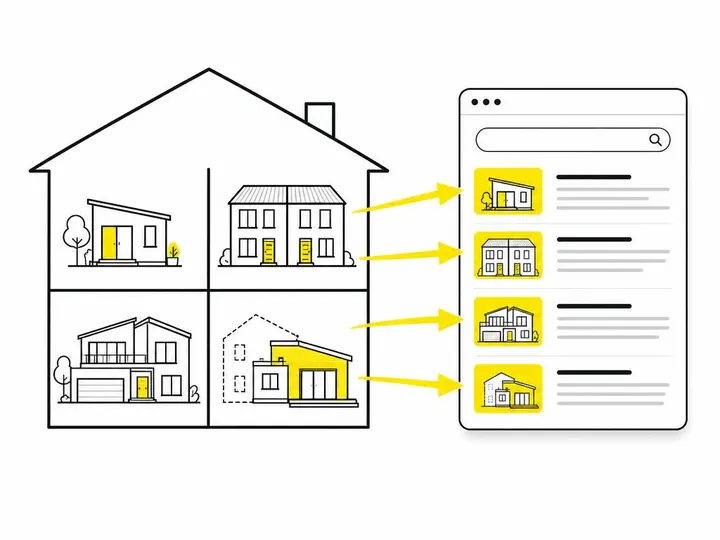
Why Do Most Builder Google Ads Fail to Convert?
Most builder Google Ads fail because clicks land on a homepage or generic page that doesn't match what the person searched. A builder landing page audit of 58 ads in October 2026, covering Sydney, Melbourne, Brisbane, Perth and Adelaide, found only 10% used a dedicated landing page.
The landing page problem most builders ignore
In that audit, 66% of ads went to existing website pages and 24% to homepages. Only 16 of 47 assessed pages (34%) named both the searched build type and the city in the headline, and 21 pages named neither. You're paying for high-intent clicks, then making people hunt.
What a high-converting builder landing page looks like
A good page follows the search exactly. Our builder landing page guide covers the structure in more depth, but the essentials are:
Build type and location in the headline
Photos of that build type, not your whole portfolio
Inclusions and an indicative budget range
Licence number, warranty and memberships
Reviews from clients with similar projects
Typical timeframe and a short enquiry form
How to qualify enquiries before they hit your phone
Conversion-qualified enquiry forms ask for the project address, intended handover date, budget range and a short project description. You'll get slightly fewer enquiries, but far more viable ones. This guide on filtering enquiries before they reach your phone explains which questions to ask without scaring off good prospects.
How Should Builders Use Meta Ads Differently From Google Ads?
Builders should use Meta Ads (Facebook and Instagram) to reach people early in the planning stage and pre-qualify them, while Google Ads captures people actively searching for a builder now. Meta is about inspiration and nurturing; Google is about demand that already exists.
Lead magnets that work for builders
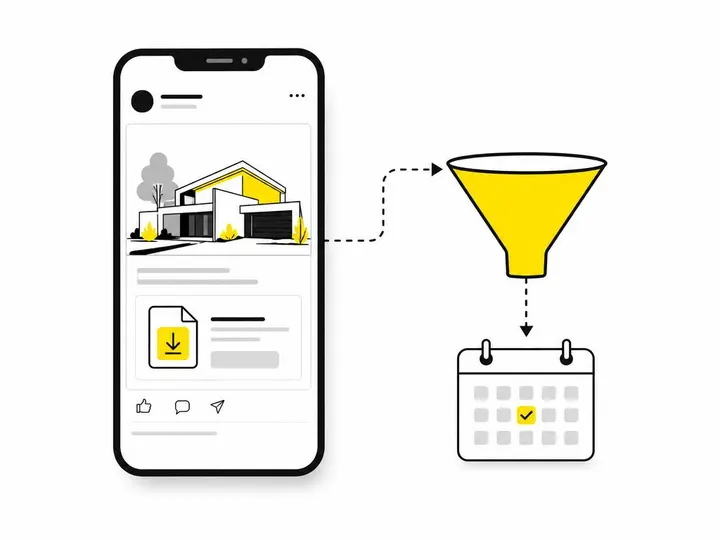
Offer something useful in exchange for contact details: a knockdown rebuild cost guide, a granny flat approvals checklist, a floor plan pack or an inclusions comparison sheet. Anyone downloading a 20-page cost guide is telling you they're serious.
Retargeting: converting warm audiences into serious enquiries
Retarget downloaders and site visitors with completed projects of the same type, short client stories and an invitation to book a site assessment. Well-run Facebook and Instagram ads for builders often move people from "someday" to "let's talk" over a few months.
A note on Meta's evolving platform terms
Meta's revised Commercial Terms, which reportedly allow crawling of business websites for AI training, were due on 30 October 2026, but later reports said they'd been delayed to 20 November after industry objections. Check Meta's current terms and your AI and data settings before relying on any summary.
Social Proof: Make Your Project Evidence Machine-Readable
Project proof works best when it's published as readable text, not locked inside image galleries. Clients and AI systems both need words to understand what you built, where and for whom.
Why galleries alone are not enough
For each project, write the build type, suburb, approximate budget range, build time and a short client quote alongside the photos. A gallery titled "Project 14" tells nobody anything.
Awards, licences and memberships on the page as text
List licence numbers, warranty insurance, Housing Industry Association (HIA) membership and awards in plain text. The 249-site analysis observed AI assistants mentioned builders with on-site awards 63% of the time versus 40% without, an exploratory finding rather than proof of cause. More on trust signals on a builder website here.
Google reviews and AI review summaries in 2026
Google AI Review Summaries in Search Ads are reportedly live in Australia, condensing your reviews into a short blurb. Keep your Google Business Profile active and ask every client for a review that mentions the build type and suburb.

What Should a Builder Spend on Each Marketing Channel?
Most Australian builders should start with roughly $2,000 to $5,000 a month in Google Ads spend, $1,000 to $2,500 on Meta, and $1,500 to $4,000 on SEO, adjusted to job value and capacity.
Realistic starting budgets for Google Ads, Meta and SEO
Google Ads: fastest results, highest cost per click in metro areas
Meta: cheaper reach, slower nurture cycle
SEO: three to six months before meaningful traction, then compounding returns
How to measure cost per booked job, not just cost per lead
A $40 lead that never signs is worse than a $400 lead that becomes a $500,000 build. Track every enquiry through to signed contract. This guide to measuring cost per booked job shows how.
Putting It Together: A Simple Construction Marketing Plan
The simplest plan is to use Google Ads for immediate demand, SEO for long-term pipeline, and Meta for nurturing future clients, all backed by visible proof.
Sequence the channels to the job pipeline stage
If your pipeline is thin, start with Google Ads to dedicated landing pages. Once steady, invest in SEO pages per build type. Layer Meta on top to fill the pipeline six to twelve months out.
Quick-win checklist for builders starting out
Pick your two most profitable build types
Build one landing page for each, with location in the headline
Add qualifying questions to every form
Publish licences, HIA membership and awards as text
Ask your last five clients for Google reviews
Conclusion
Construction marketing in 2027 rewards specificity. Search demand is shifting toward defined build types like granny flats and house and land packages, Google is assembling answers through AI Mode, and most competitors are still sending ad clicks to homepages. That gap is your opportunity.
The practical takeaway: choose the jobs you want, build a matching page for each, qualify every enquiry and judge your marketing by cost per signed contract. Start with one build type this month and do it properly before expanding.