How to Calculate Marketing ROI for an Australian Small Business

On this page 7 sections
Key takeaways
- Use gross profit not revenue when calculating marketing ROI
- A high ROAS can still mean a loss once product costs and fees are included
- Include staff time and software costs in every channel's true cost
- Compare channels on different time horizons: paid ads deliver fast, SEO takes longer
- Separate new-customer profit from repeat revenue to get a full picture
- Only 29% of ANZ B2B marketers can confidently prove marketing's revenue contribution
Most Australian small business owners track clicks, impressions and platform-reported conversions, then wonder why a campaign that looks profitable on the dashboard loses money when the bills arrive. The problem isn't the marketing, it's the scoreboard. This guide shows you how to calculate the true return on marketing investment using the numbers that matter: gross profit, customer acquisition cost, and actual revenue after expenses.
Why clicks and impressions are the wrong scoreboard
Your advertising platform's dashboard is designed to sell you more ads, not to tell you whether your marketing makes money. A high click-through rate, a large audience reach, or even thousands of platform-reported conversions can all coexist with negative profit if you don't know the full cost of winning each customer.
What platform dashboards actually show you
Google Ads, Meta, LinkedIn and other platforms report metrics like cost per click, impressions, clicks and attributed conversions. These numbers are useful for day-to-day campaign management, but they skip over crucial information: the cost of the product sold, the time your team spent following up, the software fees, the refunds, and the profit margin on each sale.
A platform conversion might be a phone call that takes three follow-up visits to close, or a form submission that bounces when your team calls. A "sale" in Google Ads might be a $5,000 order with 65 percent cost of goods sold, leaving you $1,750 gross profit, or a low-margin item worth $300 gross profit on the same ad spend.
Why a 4x ROAS can still lose you money
Return on ad spend (ROAS) is the ratio of attributed revenue to ad spend. A 4x ROAS means you sold $4 in revenue for every $1 spent on ads. Sounds great until you map it against your actual costs.
Imagine you spend $1,000 on Google Ads and drive $4,000 in revenue. Your ROAS is 4x. But if your products cost you $2,400 to deliver and you spent $800 on staff time to close and fulfil those orders, your gross profit is just $800. Subtract a $600 software subscription and a $250 agency retainer that month, and you've lost $50 on the whole campaign. The ROAS looked perfect. The profit was negative.
This is why tracking your marketing numbers using gross profit matters far more than chasing a high ROAS. You need to know what each pound of revenue actually buys you.
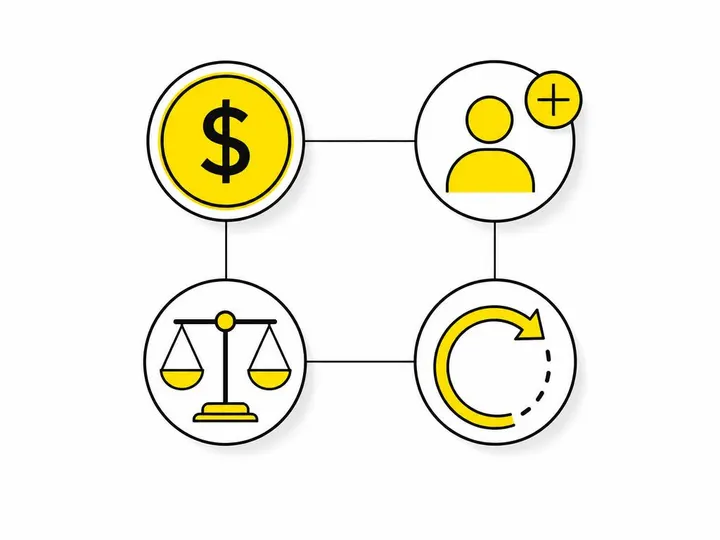
The four numbers every small business owner needs
Before you can calculate whether a marketing channel works, you need to know four foundational figures for your business. Without these, you're guessing.
Gross profit per sale
Gross profit is the revenue from a sale minus the cost of goods sold (COGS) or direct delivery cost. If you sell a service or product for $1,000 and it costs you $600 in materials, labour, delivery or outsourced delivery, your gross profit is $400. This is the pot of money available to pay for marketing, wages, overheads, tax and your profit.
Calculate your average gross profit per sale by adding up your total revenue for a month, subtracting all direct costs (materials, subcontractors, delivery), and dividing by the number of sales. For a services business, use billable hours minus the cost of those hours. Most small businesses aim for 50 to 70 percent gross margin, though this varies by industry.
Customer acquisition cost (CAC)
Customer acquisition cost is the total cost to win a new customer divided by the number of new customers acquired. This includes ad spend, staff time, software, content production, referral fees, and any other expense that brought that customer to you.
If you spent $2,000 on Google Ads, $500 on a freelance copywriter, $200 on a booking software subscription, and your sales person spent 10 hours following up at an effective hourly cost of $50, your total marketing spend is $3,000. If you acquired 5 new customers, your CAC is $600 per customer. This is often called your true cost per acquisition.
Break-even CAC and break-even ROAS
Your break-even CAC is the maximum you can afford to spend acquiring a customer without losing money on that customer's first purchase. It's calculated from your gross profit margin. Use our break-even ROAS calculator to find this figure for your business in seconds, or work it out by hand.
If your gross margin is 50 percent, your break-even ROAS is 2.0x (meaning you need $2 in revenue for every $1 of ad spend). If your margin is 40 percent, break-even ROAS is 2.5x. If your margin is 60 percent, it's 1.67x. The formula is simple: break-even ROAS equals 1 divided by your gross margin as a decimal.
Once you know this, you know whether a channel is even viable. If your CAC is $600 and your average first-purchase gross profit is $400, you're losing money on every new customer from day one. You'd need to either improve margins, reduce CAC, or focus on repeat customers to justify the investment.
Customer lifetime value
Customer lifetime value (CLV) is the total gross profit you expect to earn from a customer across all their purchases with you. If a customer spends an average of $2,000 per year with you for 5 years, and your gross margin is 50 percent, that customer's lifetime value is $5,000.
This changes the maths entirely. A CAC of $600 that looks hopeless on a first sale becomes sensible if the customer lifetime value is $5,000. You can afford to lose money on the first purchase knowing the customer will be profitable over their lifetime. However, only calculate CLV for channels and customer types where you actually see repeat purchases. Don't assume it.
How to calculate marketing ROI: the core formula
Marketing ROI is the profit generated by a marketing campaign divided by the cost of that campaign, expressed as a percentage. It answers the question: for every dollar I spent on marketing, how many cents of profit did I make?
The correct formula is: Marketing ROI equals (incremental gross profit minus marketing cost) divided by marketing cost, multiplied by 100. A positive result means the campaign made money. A negative result means it lost money. Zero means you broke even.
Step-by-step worked example
Let's say you run a digital marketing agency in Melbourne. In November 2026, you spend $1,500 on Google Ads, $300 on Mailchimp, and 15 hours of your time at $75 per hour (totalling $1,125). Your marketing spend is $2,925.
Google Ads drives 12 new leads. Your sales process converts 3 of those to paying clients at an average contract value of $4,000. Your gross profit on that revenue (before agency costs) is $2,400 (60 percent margin). Email nurturing also contributes 2 additional repeat customers from your existing list, generating $1,200 gross profit.
Total incremental gross profit: $3,600. Total marketing cost: $2,925. Marketing ROI is ($3,600 minus $2,925) divided by $2,925 times 100, which equals 23 percent. You made 23 cents of profit for every dollar spent on marketing that month. This is a reasonable return for a growth-stage business.
Marketing ROI vs ROAS: what is the difference?
ROAS (return on ad spend) divides attributed revenue by ad spend only. It doesn't account for the cost of goods, delivery, refunds, staff time or customer service. ROAS is useful for day-to-day campaign tuning, but it's not a profit measure.
Marketing ROI divides gross profit (not revenue) by the total cost of marketing, which includes ad spend, staff time, tools, content, and any other cost tied to acquiring or nurturing that customer. Marketing ROI tells you whether you actually made money. ROAS tells you how much revenue you attributable to an ad spend, but not whether that revenue left you better or worse off.
A 4x ROAS and a 4x marketing ROI are completely different outcomes. Use ROAS to manage campaigns. Use marketing ROI to decide whether to keep running them.
How to compare channels fairly
The mistake most small business owners make when comparing channels is treating them as if they're all the same type of investment. They're not. Some channels deliver immediate conversions. Others build value over months. Some have high upfront costs and low ongoing fees. Others cost almost nothing until you measure the staff time.
Include the full cost of 'free' marketing
When you see that email marketing is the highest-ROI channel among Australian marketers according to the 2026 Dotdigital Australian Marketer Survey at 22 percent of respondents, understand that this doesn't mean email is actually free. It means the people running email campaigns are including all their costs when they measure.
Email, organic search, referrals and content marketing all carry hidden costs: your time writing emails or content, software subscriptions, website hosting, payment processing, customer service for inquiries those channels generate, and the staff hours spent nurturing leads that come through those channels. When you calculate CAC for these channels, include every one of those costs. Then compare fairly against paid channels like Google Ads and Meta Ads.
Measure channels on the right time horizon
A Google Ads campaign can show a return within days. SEO typically takes 6 to 12 months to produce measurable revenue. If you judge SEO by the same monthly clock as paid search, you'll kill it before it works. The State of B2B Marketing ANZ 2026 research shows that 27 percent of Australian marketers ranked content and organic search as leading priorities, yet only 29 percent said they could confidently prove marketing's contribution to revenue. This gap suggests businesses are underinvesting in slower channels because they can't measure them quickly enough.
Create separate reporting for channels with different time horizons. Judge paid search on a 30 to 90 day window. Judge SEO and content on a 6 to 12 month window. Judge referral and email programmes on a 12 to 24 month window. This prevents you from defunding channels that work but work slowly.
Separate new customers from repeat customers
A customer acquired from Google Ads in October might generate a first-purchase revenue of $1,200 but a lifetime value of $6,000 across 3 years of repeat purchases. Your email list might drive 40 percent repeat customer orders. When you measure ROI, separate first-purchase gross profit from repeat customer revenue. Report them on different lines so you can see which channels are efficient at new-customer acquisition and which are efficient at retention and upsell.
Google's October 2026 updates to customer lifecycle goals now make this easier within the platform. You can bid differently for new customers versus returning customers, and measure new-customer acquisition and retention separately. Use this to your advantage when reporting ROI.

A simple monthly reporting template
You don't need a sophisticated marketing analytics platform to measure ROI accurately. A spreadsheet works fine if you're disciplined about what you track.
What to track for each channel
For each marketing channel (Google Ads, Meta, email, SEO, referrals, content, affiliates), track these columns every month: total spend (all-in cost including staff, software and agency fees), qualified leads generated, number of new customers, number of repeat customers, total revenue attributed to that channel, gross profit on that revenue, customer acquisition cost, and marketing ROI. Use our monthly reporting template for small business as a starting point and customise it to your business.
How to read the numbers honestly
When you have a month where a channel shows a negative ROI, don't ignore it. Investigate why. Is the CAC higher than usual because of seasonal factors? Are you investing in customer retention that won't show profit until next month? Are you testing a new message or audience that needs time to optimise? Or is the channel genuinely unprofitable and needs to stop?
If a channel shows positive ROI but the CAC is higher than your average customer lifetime value, you have a timing problem, not a profitability problem. You're acquiring customers that will become profitable, but not in the first month. This is fine as long as you have cashflow to fund it and you're confident in the repeat revenue.

Common mistakes Australian small businesses make
After working with hundreds of small business owners, the same measurement mistakes come up repeatedly.
Trusting platform attribution as proof
Google Ads, Meta and other platforms use mathematical attribution models to decide which touch point should "get credit" for a conversion. These models are educated guesses, not facts. A customer might click your Google Ad, leave, search for you again organically, click an email, then call you directly. Which channel deserves credit? The platform makes a choice, but it's not gospel.
Use platform data for campaign optimisation, but cross-check with your CRM, customer surveys, and finance records. If platform reports say Google Ads is driving 40 percent of revenue but your CRM says 25 percent of customers mentioned finding you via Google Search, adjust your confidence in the metric. Only 29 percent of ANZ B2B marketers report high confidence in their ability to prove marketing's contribution to revenue, and low confidence is often the right response when you're comparing platform attribution to reality.
Ignoring referrals and email because they feel free
Referrals were the largest primary lead source for B2B marketers at 32 percent according to the State of B2B Marketing ANZ 2026 research. Yet many small businesses don't measure the cost of referral generation: the time spent asking customers, the rewards offered, the follow-up on referrals, the time invested in building referral relationships. Once you include these, referral CAC becomes visible and comparable to paid channels.
The same applies to email and organic social. These aren't free. They cost your time, your software subscriptions, and your team's attention. Measure them as you would any other channel, and you'll have an honest comparison.
Judging SEO by the same clock as Google Ads
SEO takes time. Google Ads produces results in weeks. If you measure both on a 30-day basis, SEO will always look bad in the early months. Then when it finally produces traffic and customers 8 months later, you've already killed the programme and missed the payoff. Content and organic search were cited as leading priorities by 27 percent of Australian marketers in the 2026 Dotdigital findings, but you can't judge them on a paid-search timeline.
Conclusion
Marketing ROI is the percentage of gross profit you make for every dollar of marketing spend. It's different from ROAS because it includes all your costs: product, delivery, staff time, software, and agency fees. It's different from platform metrics because it measures profit, not just attributed revenue or engagement.
To calculate your marketing ROI, you need four baseline numbers: your gross profit per sale, your customer acquisition cost, your break-even ROAS, and your customer lifetime value. Once you have these, you can measure any channel fairly by calculating the gross profit it generates, subtracting the full cost of running that channel, and dividing by cost.
Start with a simple spreadsheet. Track spend, leads, customers, revenue, gross profit and ROI by channel each month. Include the full cost of "free" channels. Measure slow channels on a longer timeline than fast ones. Separate new-customer profit from repeat revenue. Over three months, you'll see which channels actually make you money and which ones look good in the platform but drain your profit. That's the scoreboard that matters.