AI Marketing Tools for Small Business: What Is Worth Paying For?

On this page 7 sections
Key takeaways
- Use AI tools already built into Meta and Google before paying for anything extra
- Pay for tools that save real hours or improve lead quality, not novelty
- Human review of AI-generated ad content is now a legal requirement under Meta's 2026 terms
- Only 16% of small businesses use agentic AI, so start simple and build up
- Calculate subscription cost plus training time against a measurable baseline return
Most Australian small business owners are now using some form of AI, but adoption is running far ahead of training and clear ROI frameworks. With Meta charging 14% more per impression in 2026 and Google expanding AI-powered ad features into Australia, the real question is not whether to use AI marketing tools, but which ones are actually worth paying for.
Why Australian Small Businesses Are Paying for AI (and Why Many Are Wasting Money)
A Meta-commissioned YouGov survey of 3,983 small-business owners across nine Asia-Pacific markets in 2026 found that 84% use AI in some form. Of those, 76% reported positive productivity gains and 71% reported revenue uplift. The numbers sound compelling until you dig deeper: 86% of respondents also said small businesses need more guidance to gain the full benefit of AI, and 51% identified training costs as a barrier.
What that tells you is clear. Adoption is running ahead of strategy. Too many small business owners have subscribed to AI tools without asking the right questions first, or they are paying for capabilities they already have built into Meta and Google accounts.
Adoption is ahead of training
Among small-business owners using AI, 51% use it to create or edit content, 43% for local advertising and marketing, and 37% for customer support. Very few are using truly automated workflows. Only 16% of small businesses use agentic AI for large-scale tasks such as email campaigns, and just 9% for processes like payroll. That is not a limitation of the tools. It is a reflection of the governance and approval frameworks small teams simply do not have in place yet.
The tools most small businesses actually use
The practical reality is that most small business owners are using AI for drafting, creative resizing, summarising data and generating ad copy. Those are helpful but not transformative uses. The tools that move the needle are the ones that connect directly to your business engine: lead qualification, customer response, campaign testing and performance reporting.
The Framework: Pay for Outcomes, Not Novelty
Before paying for any AI marketing tool, ask yourself four questions that separate genuine business value from vendor hype.
Four questions to ask before paying for any AI tool
Does it save measurable staff time? Calculate the hours your team currently spends on the task. If a tool saves fewer than 5 to 10 hours per month, it is probably not worth the subscription cost and training burden.
Does it improve the quality of your leads or conversions? A tool that generates more inquiries but wastes your time on poor-quality leads has a negative ROI. AI lead qualification for small business is worth paying for because it filters; a chatbot that accepts every inquiry is not.
Does it integrate with your existing stack? If the tool sits alone and requires manual data entry or export to your CRM, email platform or accounting system, most of the time savings evaporate. How automation fits into a small business marketing stack matters more than the tool itself.
Can you measure the return in hard numbers? More leads at a lower cost per conversion, faster response time reducing lost sales, or additional test cycles per month that existing staff could not run. If you cannot articulate the metric, you cannot justify the cost.
Low-cost tools versus high-value subscriptions
There is a world of difference between a $15-a-month content-writing assistant and a $200-a-month lead-qualification or reporting platform. The first is a convenience; the second is a workflow engine. For most small businesses, it is smarter to start with low-cost tools and move to paid subscriptions only when you can prove they close a specific gap in your business process.
Start With the AI You Already Have
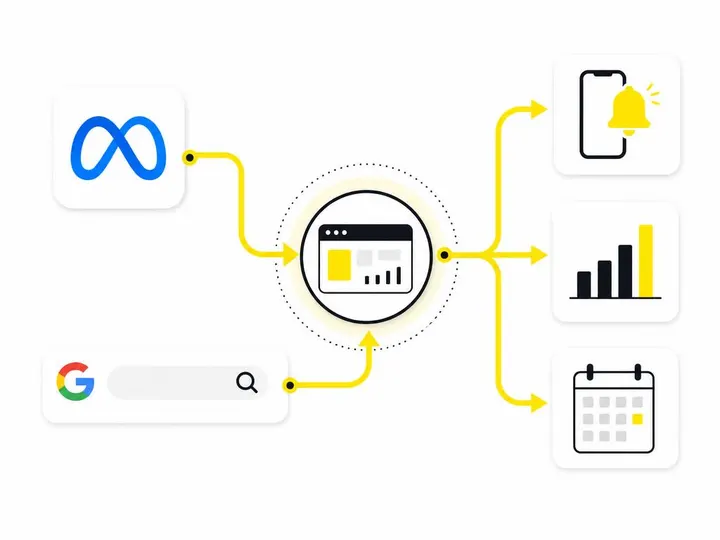
Before opening your wallet, test the AI tools already included in your Meta and Google ad accounts, because they are improving fast and they integrate seamlessly with your existing campaigns.
Meta's built-in AI advertising tools
Meta Advantage+ is now a $75 billion annual revenue run rate business, and nearly 10 million advertisers used Meta's generative AI creative tools in Q3 2026. The platform will now generate images, test audience combinations, optimise bid strategies and recommend budget allocation without you lifting a finger. The Meta Business Assistant, in particular, has been shown to generate almost 5% more conversions at the same cost per conversion for advertisers who act on its recommendations.
Google AI Mode and Performance Max
Google is expanding AI Mode advertising into Australia as of November 2026. This means your existing Search, Shopping and Performance Max campaigns can now appear in Google's AI Overviews and be optimised by Google's ranking systems. Those systems delivered an 8.3% increase in clicks and 15.7% uplift in conversions on Facebook in Q2 2026 according to Meta's internal reporting. The point: you do not need to buy a separate tool to get AI-powered campaign optimisation. It is already running on your account.
Where Paid AI Tools Actually Earn Their Keep
Once you have squeezed maximum value from free and built-in AI features, there are four specific areas where paying for a third-party AI tool delivers real return for Australian small businesses.
CRM and lead handling
Responding to leads faster with AI is a proven small-business win, especially in competitive local markets. AI-powered CRM tools can automatically log incoming leads from multiple sources, score them by purchase intent, and trigger follow-up sequences. What you are buying is speed and consistency, not creativity. For a business that loses sales to slow response, this is worth $100 to $200 per month.
Reporting and campaign analytics
AI-powered reporting tools can pull data from Google Ads, Meta, your website and your CRM, then surface anomalies, trends and recommendations in plain English. When working out whether a marketing investment is paying off, the ability to see which campaigns or audience segments are truly profitable saves time that would otherwise go to spreadsheet wrestling.
Content production at scale
If you run more than one location or sell into multiple customer segments, AI content generation tools can produce localised social-media posts, landing-page variations and product descriptions faster than hiring freelancers or doing it yourself. This is worth paying for when you need 20 to 50 pieces of content per month, not five.
Customer service triage
AI chatbots or intelligent routing tools that sort incoming customer questions by urgency and category, then escalate complex issues to your team, can reduce response time and improve customer satisfaction. This is especially valuable for businesses with high-volume enquiry streams but limited support staff.
The Human Review Step You Cannot Skip
Meta's Commercial Terms took effect on 20 November 2026, and they shift responsibility for AI-generated and AI-modified ad content directly to you. If Meta's system tweaks an image or headline, you are liable for accuracy, misleading claims, pricing errors and compliance with regulations.
What Meta's November 2026 terms mean for advertisers
This is not abstract. If you use Meta's AI-powered creative generation tools and they inadvertently change a price, mislead on eligibility, or alter an image in a way that breaches regulations, you are accountable. The platform is not.
A simple approval checklist
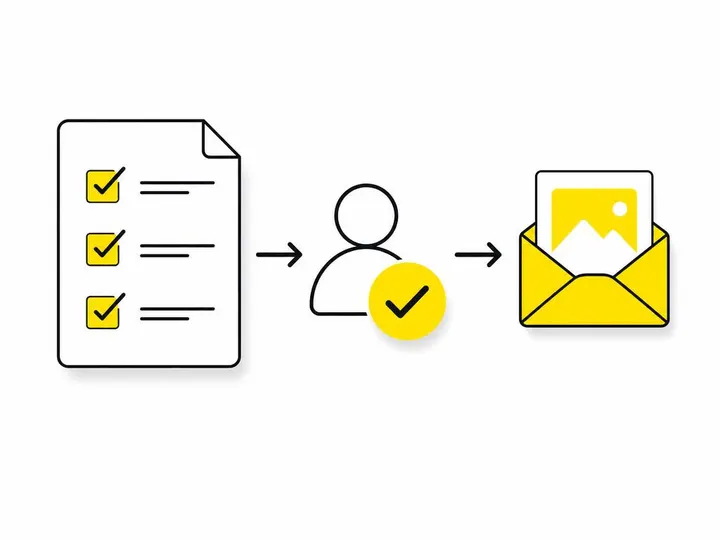
Before any AI-generated ad, email or landing page goes live, run it through this filter: Does the copy contain factual claims you can verify? Are prices accurate? Does the image represent the product fairly? Does it comply with industry regulations (financial, health, gambling, etc.)? Is the audience targeting correct? Only when you can answer yes to all five should you publish. This takes 10 to 15 minutes per campaign. It is not optional.
How to Calculate Whether a Tool Is Worth It
The real cost of an AI tool is never just the subscription price.
The real cost equation
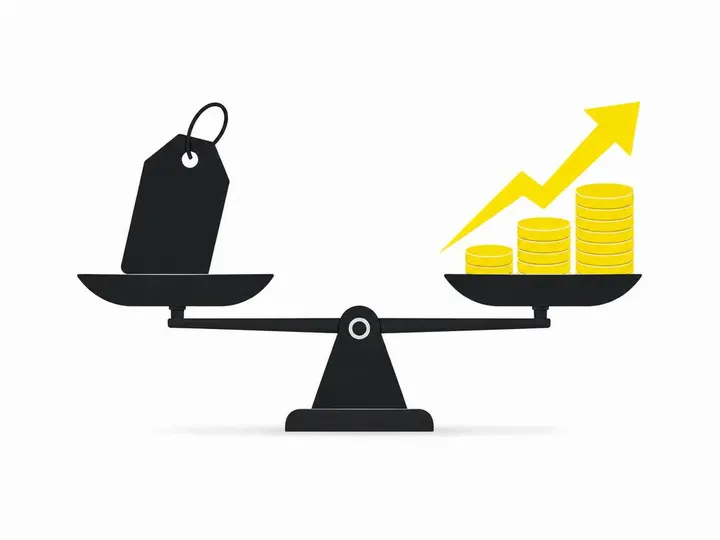
Total cost equals subscription fee plus setup time plus ongoing training plus quality review. For a $150-a-month tool, that might be $150 plus 10 hours of setup and training (at $50 to $100 per hour for your time) plus 5 hours per month of review and troubleshooting. That is $150 to $300 in pure subscription cost plus $500 to $1,500 in labour to get it working, plus $250 to $500 per month in ongoing labour. You are looking at $800 to $2,500 per month in total cost, not $150.
A worked example for a small business
Say you currently spend 15 hours per week responding to leads, qualifying them and following up. A paid AI lead-qualification tool costs $200 per month. It takes 15 hours to set up and integrate with your CRM, then 3 hours per week to review and refine scoring rules. After month one, it cuts your manual time to 8 hours per week. At $60 per hour (your loaded cost), you are saving $420 per month in labour minus the subscription cost of $200, netting $220 per month. Add in improved conversion quality (fewer poor-fit leads wasting your time) and the ROI becomes clear. That tool is worth it.
Compare that to a $40-a-month social media content-writing tool that might save you 2 hours per week. That is $120 in labour savings against $40 subscription cost, netting $80 per month. The tool still pays for itself, but you have to decide whether $80 per month justifies managing another login, another vendor relationship and another approval step.
Conclusion
AI marketing tools are worth paying for when they solve a specific, measurable problem in your small business workflow. The challenge is not technology availability; it is clarity about what your team actually needs and what your budget can sustain.
Start by maximising the AI features already built into Meta Advantage+ and Google Performance Max. Test low-cost general-purpose tools to see if they fit your process. Only move to paid specialist subscriptions when you can point to hours saved, better-quality leads, improved conversion rates or lower cost per acquisition. And do not skip human review, especially now that Meta has made you legally responsible for AI-generated ad content.
Optimising for AI search in Australia is becoming table stakes for visibility, but the real payoff from AI comes from automating the work that slows you down. Measure twice, pay once.