How to Use AI to Turn Customer Reviews into Marketing Content
On this page 7 sections
Key takeaways
- Reviews are ready-made marketing content. AI just formats them faster.
- Paste reviews into ChatGPT with a clear prompt to get social, web, or ad copy.
- Prioritise reviews that mention location, price, or a specific outcome.
- Always edit AI output to keep your brand voice and stay accurate.
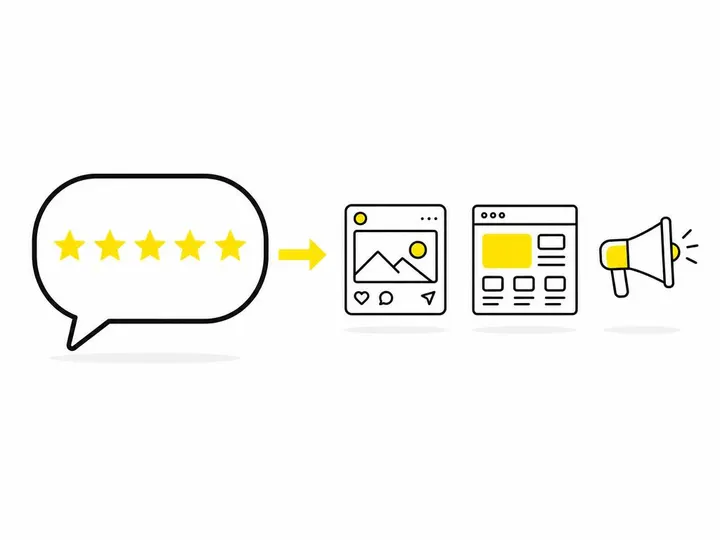
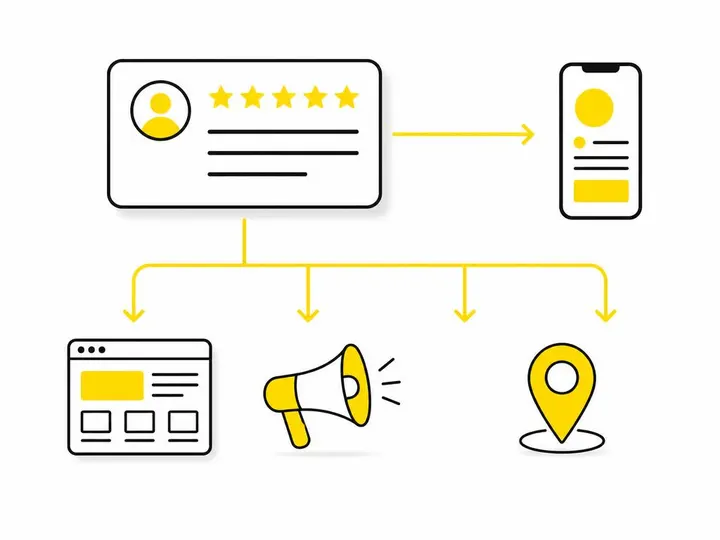
- Repurpose one strong review across four or five different content formats.
Customer reviews are the most authentic marketing asset you own, yet most small business owners file them away and never look at them again. The honest truth is that reviews from real customers convert better than almost any copy your marketing team can write, because people trust other customers more than they trust you. The smarter move is to turn those reviews into a machine that feeds your social media, website, and ad campaigns every single week using AI. We'll walk you through the exact process, the tools that work, and how to keep it all honest.
Why Your Google Reviews Are an Untapped Content Asset
Every review you receive is a piece of authentic user-generated content that your customers have already written and validated as true. Your job is to extract the best bits and reshape them for every channel where your customers hang out. That's not plagiarism or dishonesty; it's smart business, and AI tools help you scale this kind of content repurposing without needing professional copywriters on staff.
The real cost of ignoring reviews as content
If you're not using your reviews as marketing content, you're paying for content creation you don't need. A professional copywriter costs $100 to $250 per hour for website copy or social posts. A designer costs $50 to $150 per hour. Over a year, that's thousands of dollars to create testimonial sections, social proof, and ad creative. Meanwhile, your customers are handing you proof statements for free. The only cost is the time to reshape them, and AI cuts that time by 70 to 80 percent.
Why review language converts better than brand copy
When a customer says "These guys fixed my leaking roof in one day and actually cleaned up after themselves," that lands harder than "We provide fast, professional roofing services." The first one is specific, honest, and uses the customer's own voice. Ad platforms like Meta Ads reward this kind of social proof in copy because the algorithm knows people engage with it more. Reviews become stronger ad copy, stronger testimonial sections, and stronger social posts because they're not marketing language at all.
Step 1 — Collect and Sort Your Best Reviews
You can't turn reviews into content if you don't know where they are or which ones matter most. Start by gathering reviews from every platform where customers leave them, then filter for the ones that will actually move the needle in marketing.
Where to find your reviews (Google, Facebook, industry directories)
Most small businesses get reviews on Google Business Profile, Facebook, and maybe one or two industry-specific sites depending on your trade. Google is usually your primary source because Google Business Profile reviews appear in local search results and on your business listing. Facebook reviews sit on your Page. If you're a plumber, electrician, or builder, you might also have reviews on ServiceSeeking, Hipages, or Oneflare. Spend an hour pulling your best reviews from each source into a single Google Doc or spreadsheet so you can see them all at once.
Which reviews to prioritise for marketing use
Not every five-star review is worth repurposing. Prioritise reviews that mention:
Specific results or outcomes (not just "Great service")
The problem you solved (the context that hooks readers)
Speed, reliability, or value (the things that sell)
How the customer felt before and after
Local or location-specific details (helps local searchers)
A review that says "Amazing electrician" is too generic. One that says "Fixed our faulty switchboard within 24 hours, reasonably priced, and the team actually explained what was wrong" is gold for marketing. Focus on those.
Step 2 — Feed Reviews into an AI Tool with the Right Prompts
The difference between mediocre AI output and great marketing content is the quality of your prompt. ChatGPT and similar tools don't read minds; they respond to clear, specific instructions. Prompt engineering is just the art of asking the right question in the right way.
Basic prompt structure that works
Your baseline prompt should always include: the review itself, the output format you want, the tone you want, the channel it's going on, and any restrictions (like character limits or brand voice guidelines). A simple version looks like this:
"Take this customer review: [insert review]. Rewrite it as a short Instagram caption (max 150 characters). Keep the customer's voice. Make it punchy and focus on the result they got."
Prompts for social media posts
Social media needs short, snappy, visual language. Try: "Turn this review into a 3-line Facebook post that highlights the main benefit. Use simple language, one emoji if it fits naturally, and end with a question or call to action that encourages engagement. Review: [insert review]."
Prompts for website testimonial sections
Website testimonials can be longer and more polished. Use: "Rewrite this review as a formal testimonial for our website's homepage. Keep it under 60 words. Include the customer's name and job title if available. Make it sound authentic but professional. Review: [insert review]."
Prompts for ad copy and headlines
Ad copy for Australian tradies needs to be benefit-focused and urgent. Try: "Create three different ad headlines (under 30 characters each) based on this customer review. Each should highlight a different benefit (speed, quality, or value). Review: [insert review]."
Step 3 — Adapt AI Output for Each Channel
AI gives you a starting point, not a finished product. You still need to tweak the output for each channel's format, audience, and rules.
Instagram and Facebook posts
Instagram works best with shorter posts, emojis, and hashtags. Facebook allows longer text but rewards posts that start with a hook. Take your AI-generated version and ask: Is there a specific number or dollar amount I can add? Can I make the first line more surprising? Does this need line breaks for readability?
Google Business Profile posts
Google Business Profile posts should be short and include a call to action. AI can generate the core message, but you need to add urgency or a reason to click. A review about fast service becomes "See why we fix jobs faster than anyone in town. Read 200+ five-star reviews on our profile."
Website service pages and homepages
Website copy needs context. A review sits alone on social media, but on your website, it should support the section heading. AI helps polish the review, but you write the framing sentence above it that tells visitors why this review matters.
Meta ad creative and headlines
Meta Ads let you test multiple headlines and description text against the same image. AI can generate five variations of a testimonial-based headline in minutes. AI tools for social media management often integrate with ad platforms so you can push these variations straight into ad creation workflows.
What to Watch Out For (and How to Keep It Honest)
Using AI with customer data comes with real responsibility. These are people's words, and your reputation depends on handling them right.
Never fabricate or exaggerate a review
Don't ask AI to invent review quotes or embellish real ones. It's illegal under Australian Consumer Law, it damages trust if someone fact-checks you, and it's simply not necessary when real reviews are stronger than anything you'd write. Use only reviews you've actually received.
What not to share with ChatGPT
Don't upload customer names, phone numbers, email addresses, or sensitive personal information into ChatGPT. Your customers didn't consent to that. Share only the review text itself. If a review includes identifying details you want to remove, edit them out before you paste the review into the tool.
Keeping your brand voice consistent
AI can drift between formal and casual depending on your prompt. Read every piece of AI output and edit it to match your actual tone. If your brand is straightforward and no-nonsense, strip out flowery language. If you're friendly and conversational, make sure the final copy feels like it came from your team, not a robot.
Building a Simple Weekly Review-to-Content Routine
The only way this actually works is if you build a habit. It doesn't have to be complex.
A realistic 30-minute workflow
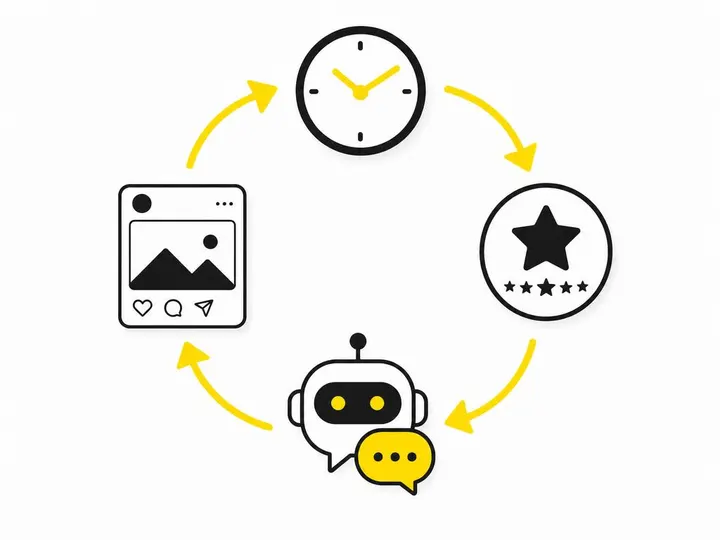
Monday morning: spend 15 minutes pulling your two best new reviews from Google, Facebook, or Hipages into a document. Spend 10 minutes running each one through ChatGPT with your standard prompts (one for Instagram, one for website, one for an ad headline). Spend 5 minutes editing the output and scheduling posts. That's it. One hour per week feeds you four to eight pieces of authentic marketing content across different channels. Using AI to write social media captions works best when you batch it like this instead of doing it ad hoc.
Tools that can automate parts of the process
If you want to go deeper, tools like Zapier or Make can automatically notify you when new reviews land. Some AI tools for social media management have built-in review monitoring dashboards. You don't need all of it; even a simple spreadsheet with a weekly reminder gets the job done for most small businesses.
Conclusion
Your customers have already written your best marketing copy. AI just makes it faster and easier to repurpose it across Instagram, Facebook, Google Business Profile, your website, and ad campaigns. The step-by-step process is straightforward: collect your best reviews, feed them into ChatGPT with specific prompts, adapt the output for each channel, and build a weekly 30-minute routine so it actually happens.
The key to making this work honestly is simple: never fabricate or exaggerate, keep the customer's voice intact, and remember that this is a tool to save time, not to replace real customer relationships. Done right, review-based marketing content costs you almost nothing and converts better than anything your copywriter could dream up.
Start this week by collecting your five best reviews and running one through ChatGPT. You'll be surprised how fast you can turn a single review into four different pieces of marketing content.
Frequently asked questions
How do I use AI to do reviews for my business?
What is the 30% rule for AI content?
How can AI be used to analyse customer feedback?
Can I use ChatGPT for customer service?
What should I not tell ChatGPT when using it for reviews?
Which AI tool is best for turning reviews into marketing content?

How to Use Customer Reviews on Social Media (A Repeatable System for Australian Small Businesses)

How to Use AI to Write Social Media Captions for Your Small Business