How to Use Meta Ads for Seasonal Services in Australia (2026 Guide)
Key takeaways
- Start ads 3 to 6 weeks before your seasonal peak, not during it
- Use Meta's location targeting to match your actual service area
- Lead Ads reduce friction for urgent repair enquiries
- Retargeting warm audiences costs less than cold prospecting
- Even a modest daily budget can generate real local leads
Seasonal service businesses in Australia lose money by advertising at the wrong time. Most wait until their busy season peaks to start running Meta Ads, which is already too late. You need to run campaigns two to three months before your peak season hits, when people are still searching and ready to book. This guide shows you how to set up, target, and run Meta Ads campaigns that actually fill your calendar for air conditioning, pool care, pest control, storm repairs, and other time-dependent services.
Why Seasonal Timing Is Everything for Meta Ads in Australia
Seasonal service businesses succeed or fail based on when they start advertising, not how much they spend. A pool cleaner waiting until September to run ads has already missed the spring window when homeowners first think about pool season. An air conditioning tradie running ads in January is competing with every other AC business in Australia at peak rates. The smarter play is to advertise two to three months before your busy season starts, when fewer competitors are active and cost per lead is lower.
Meta Ads reach people in the consideration phase, not the emergency phase. That matters. When someone's air conditioner breaks in mid-January, they're searching Google, not scrolling Facebook. But in October and November, homeowners are thinking ahead, comparing options, and ready to book a pre-season inspection. That's your window.
The four big seasonal service windows
Australian seasonal service demand follows predictable patterns. Air conditioning and cooling services peak from October through March, with the heaviest demand in December and January. Pool care and maintenance peak from August through March as summer approaches. Pest control runs year-round but spikes in spring (September to November) and early summer. Storm repairs are unpredictable but cluster around storm season from October to April, depending on your region.
Start your campaigns at least two months before these peaks. For air conditioning, that means August ads. For pool care, start in June. This timing lets you build awareness, test creative, and capture early bookers before everyone else floods the market.
Why advertising before the peak beats advertising during it
Cost per lead drops when fewer competitors are bidding. In October, you might pay $8 to $15 per lead for pool care services. By December, you're paying $20 to $35 per lead because every pool company in Australia is advertising. The maths is simple: start early, spend less, get more leads at lower cost. You're also reaching people in a planning mindset, not a panic mindset. Planned bookings convert better than emergency calls.
Setting Up Your Campaign: The Basics for Seasonal Services
Before you launch a single ad, you need to make three critical decisions in Meta Ads Manager: what you're optimising for, where you're showing ads, and how much to spend week by week.
Choosing the right campaign objective
Use Leads as your campaign objective for seasonal services. This is not the same as Link Clicks or Traffic. The Leads objective inside Meta Ads Manager automatically optimises your budget to find people most likely to fill out a form or contact you directly. For tradies and service businesses, this is the fastest path from ad to phone call or booking.
If you have a strong landing page (which we'll cover next), Traffic works too. But Leads usually wins for seasonal businesses because it handles the conversion optimisation for you, and the Lead Ads vs landing page choice is simpler to make once you know your own site speed and form experience.
Location targeting for Australian service areas
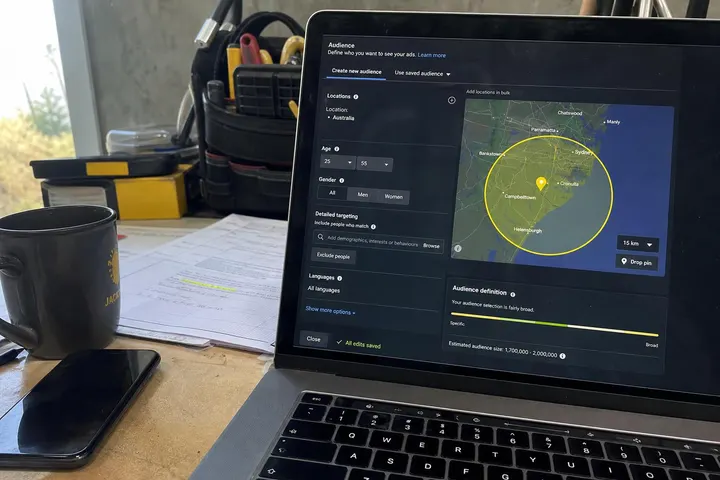
Geographic targeting is how you avoid wasting budget on people outside your service area. In Meta Ads Manager, you set location targeting by postcode radius or suburb. A tradie working in Sydney's inner west should target postcodes 2015, 2016, 2017, and a 10 to 15 kilometre radius around their base. Don't target "New South Wales" or "All of Australia" unless you're a national brand.
Be more specific if you can. If you do pool care in Randwick, Coogee, and Maroubra only, target those suburbs. If you're a storm repair specialist and only work in Greater Brisbane, set your radius to exclude the Sunshine Coast and Gold Coast. The more precise your location targeting, the lower your cost per lead.
Budget: how much to spend and when to ramp up
Start small and scale up. For a seasonal campaign, begin with $10 to $15 per day (around $300 to $450 per month) for the first two weeks. Let Meta Ads Manager learn which audiences convert. After two weeks, if you're getting leads, scale up by 20 to 25 percent. If cost per lead is climbing but quality is falling, pause and test new creative.
Many seasonal businesses ask whether $500 is enough. Yes, but only for testing. How much Meta Ads cost in Australia varies wildly by industry and location, but $500 gives you about three to four weeks of testing budget at $15 per day. That's enough to find a profitable audience and ad angle. For actual seasonal campaigns that book jobs, most Australian tradies spend $2,000 to $5,000 across a six to eight week pre-season window.

Ad Creative That Works for Seasonal Service Businesses
Your ad creative needs to scream urgency without sounding desperate. The copy, images, and format all need to work together to stop the scroll and generate a lead.
Copy angles for urgency and seasonal relevance
Write ad copy that answers "why now?" For pool care: "Spring's here. Get your pool summer-ready before the rush. Book an inspection now." For air conditioning: "Summer's coming. Avoid the January chaos. Pre-season services available now." For storm repairs: "Is your roof secure? Don't wait for the next storm. Free damage assessment." Writing Facebook ad copy for local service businesses means being direct, local, and time-sensitive. Seasonal services live or die on urgency.
Include a number or deadline if you can: "First 20 bookings get 15% off" or "Limited availability August to October." This works because people respond to scarcity.
Image and video formats that perform
Single images work best for seasonal services because they're simple and load fast. Show your work: a clean pool, a newly installed air conditioning unit, a pest-free home. Avoid stock photos of smiling families. Use your actual work and actual customers (with permission). Video ads perform well but take longer to produce. A 15 to 30 second video of a service in action (cleaning a pool, installing a unit, inspecting a roof) typically outperforms static images on engagement.
Carousel ads let you show multiple services or before-and-after shots, which works well for pest control or storm repairs.
Lead Ads vs landing page: which to use for urgent jobs
For seasonal services, Lead Ads vs website landing page is a practical choice. Lead Ads keep people on Facebook, pre-populate their name and phone number, and let them submit instantly. Landing pages let you control the full experience and tell a longer story. Use Lead Ads if you have staff to follow up quickly (within an hour). Use landing pages if your follow-up is slower or your conversion rate on-site is strong. For most Australian tradies, Lead Ads win because urgency matters, and faster response beats prettier pages.
Audience Targeting: Who to Show Your Ads To
Meta Ads let you build audiences based on interests, behaviours, and past customers. For seasonal services, combine all three.
Interest and behaviour targeting for home services
Target people interested in "Home improvement," "Home maintenance," "Gardening," or "Real estate." Behaviours matter too: people who've recently purchased a property, or who live in higher-income areas (because they're more likely to book paid services). For air conditioning specifically, target "Home & Garden" interests and people who've searched for air conditioning on Facebook. Age targeting should be 35 to 65 for most home services (the decision-makers in households).
Don't over-target. Broad targeting often wins because Meta's algorithm finds the right people without you guessing. Start with interest and behaviour, then let the platform learn.
Lookalike audiences from your past customers
Once you have 100 to 150 past customers in your database, upload them to Meta and create a Lookalike Audience. This tells Meta to find new people similar to your best customers. Lookalike Audiences usually outperform interest-based targeting because they're based on real customer data, not guesses. If you've got 500 customers, create a 1% Lookalike (most similar) and a 5% Lookalike (broader). Run ads to both and see which delivers cheaper leads.
Retargeting people who already visited your website
Set up your Meta Pixel on your website. This tracks anyone who lands on your site but doesn't book. Later, show them ads again on Facebook and Instagram. Retargeting typically costs 40 to 60 percent less than cold traffic and converts two to three times higher. For seasonal businesses, retargeting is gold because people who visited in June or July are still thinking about pool season in August and September.
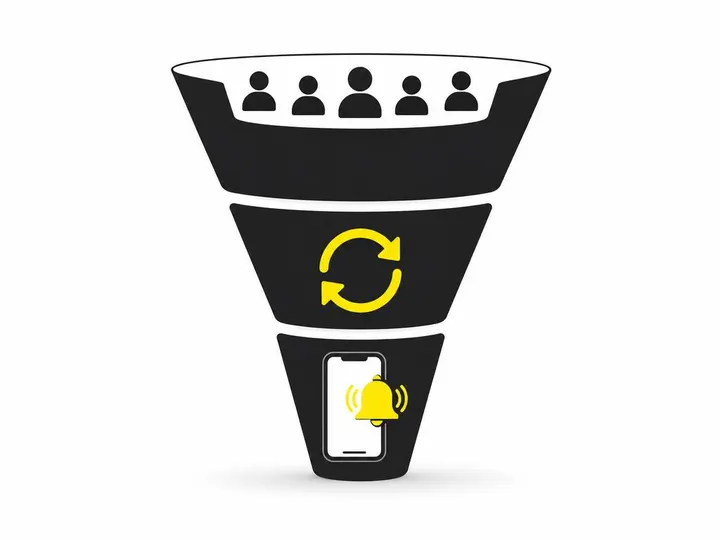
Retargeting and Follow-Up: Turning Warm Leads into Booked Jobs
Seasonal lead generation doesn't end at the first ad. You need a retargeting sequence to push warm leads towards booking.
Setting up a retargeting sequence
After someone clicks your Lead Ad and submits their details, they should see a second ad within 24 hours. This second ad thanks them, builds trust, and includes a testimonial or "As seen in" logo. A third retargeting ad (shown three to five days later) highlights a specific offer or asks them directly to book. Retargeting ads for tradies work because they remind people who showed interest. Most leads don't convert on the first touch. Retargeting catches the 60 to 70 percent who need a nudge.
Seasonal offer ads for fence-sitters
Create a fourth retargeting ad with a limited-time seasonal offer. "Book before October 31 and get $100 off your first service." or "Limited spring availability. Secure your spot now." This converts hesitant leads who are waiting for a reason to commit. For Meta Ads for tradies, this is often the final push that moves a lead from consideration to booking.
How Much Does It Cost and Is It Worth It?
The real question isn't what you'll spend on ads. It's what each lead and each job is worth to you.
Realistic Meta Ads cost expectations in Australia
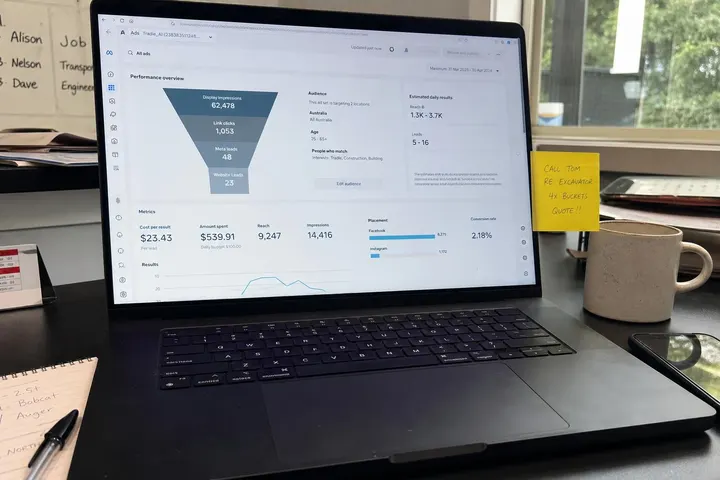
Cost per lead for Australian seasonal services ranges from $5 to $30, depending on industry and location. Air conditioning and storm repair cost more ($15 to $30 per lead) because everyone's bidding on them. Pool care and general pest control typically cost $8 to $18 per lead. Regional areas are cheaper than Sydney, Melbourne, or Brisbane. If your job is worth $800 to $2,000, a $15 lead cost is a win. If your job is worth $200, it's a loss.
Is $500 enough to run a seasonal campaign?
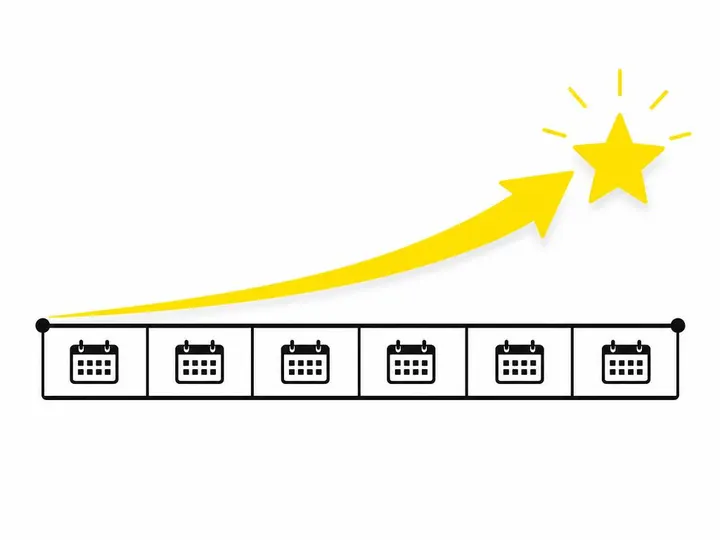
$500 is enough to test, not enough to fill your calendar. At $15 per lead, you get about 33 leads. If your conversion rate is 30 percent (typical for local services), that's 10 jobs. If each job is worth $1,000 in revenue, you've made $10,000 from $500 in ad spend. That's a 20-to-1 return. But it's thin, and weather, cancellations, and timing can change everything. Plan for $2,000 to $5,000 if you want real results. Most seasonal businesses need $3,000 to $6,000 across six to eight weeks to run a proper campaign and test multiple audiences and creative variations. However, what to budget for Meta Ads really depends on your job value and local competition.
Common Mistakes Seasonal Service Businesses Make with Meta Ads
These mistakes cost money. Avoid them.
Starting too late
Starting ads in January for an AC business is a disaster. You're competing with hundreds of other ads, costs are high, and the peak window is closing. Start in August or September. You'll spend half as much per lead.
Targeting too broadly
Targeting all of Australia or even all of New South Wales burns budget fast. A pest control business in Melbourne shouldn't reach people in Perth. Meta Ads targeting for tradies means being ruthless about geography. Target postcode radius, not states.
Ignoring the landing page experience
A great ad that lands on a slow or confusing website is wasted. Make sure your website loads in under two seconds, has a clear call-to-action, and is mobile-friendly. Most people click ads on mobile. If your site doesn't work on mobile, you're throwing leads away.
Putting It All Together: A Simple Seasonal Campaign Plan
Here's a step-by-step seasonal campaign plan you can run today. Choose your service (air conditioning, pool care, pest control, storm repairs). Decide your peak season (check ABS construction and home services activity data for Australian trends). Count back two months. That's when you start ads.
Set up Meta Ads Manager with the Leads objective. Target a 10 to 15 kilometre radius around your service area. Build audiences from past customers (Lookalike) and interests (Home Improvement). Create one static image ad with urgency copy. Set daily budget to $12 to $15. Run for two weeks. Check cost per lead. If it's under $20, scale budget by 25 percent. If it's over $30, pause and test new creative. Once you've got a winning ad, set up a retargeting sequence: thank you ad (day one), social proof ad (day three), offer ad (day seven). Measure everything in Meta Ads Manager: leads, cost per lead, and follow-up conversion rate (how many leads actually book jobs).
That's the system. Timing, targeting, creative, retargeting. Run it consistently across your seasonal windows and you'll stop guessing whether Meta Ads work. You'll know.
Conclusion
Seasonal service businesses in Australia have a timing advantage that non-seasonal businesses don't. When you run Meta Ads two to three months before your peak season, you're reaching people in a planning mindset at lower costs than everyone else bidding during the rush. The funnel is simple: cold audiences via targeted ads, warm audiences via retargeting, and closed leads via seasonal offers and fast follow-up.
Start small ($300 to $500 per month) to find your winning audience and creative. Once cost per lead drops below what a job is worth to you, scale up to $2,000 to $5,000 for a full seasonal push. Set up how to set up your first Meta Ads campaign properly and you'll avoid the common mistakes that waste budget. Track everything: leads, conversion rate, cost per job.
The businesses winning at seasonal Meta Ads aren't spending more money. They're spending smarter, earlier, and with better targeting. Your next seasonal peak starts now.