Meta Ads Targeting for Tradies: How to Stop Wasting Money on the Wrong Audience
Key takeaways
- Target 3-5km radius for service trades to avoid wasting budget on distant leads
- Layer homeowner demographics: age 30-55, household income $80k+, exclude renters
- Use interest targeting sparingly—rely on location and behaviour over hobbies
- Test lookalike audiences from past customers for scale without losing local focus
- Monitor frequency and cost-per-lead weekly to catch audience fatigue early
Most tradies waste 30 to 50 percent of their Meta ads budget showing work to people who'll never hire them. You're paying to reach someone in Brisbane when you're a plumber in Sydney, or your ad's sitting in front of renters who can't afford a new kitchen. The difference between a cost-per-lead of $5 and $15 isn't your ad copy or your offer. It's who sees your ad in the first place.
Why Most Tradie Meta Ads Target the Wrong People (and Burn Money)
The maths is simple. A plumber spending $1,000 a week on ads might get 80 leads if their targeting is tight. That same $1,000 with loose, unfocused targeting delivers 30 to 40 leads. Same budget. Different results. The difference comes down to how much of your money lands on people outside your service area, renters who can't approve a renovation, or DIY enthusiasts who'll never call a professional.
A poorly targeted campaign shows your ad to thousands of wrong people. You pay for those impressions. Your frequency (how often the same person sees your ad) balloons, your click-through rate drops, and your cost-per-lead inflates by 2 to 3 times what it should be. You're essentially running a spray and pray campaign that burns through budget without filling your phone.
The cost of showing ads to people outside your service area is brutal. A tradie in Perth doesn't need leads from Melbourne. A landscaper in Melbourne CBD shouldn't pay to reach someone 25 kilometres away in the outer suburbs. But without deliberate targeting in Meta Ads Manager, that's exactly what happens. You set up a campaign, maybe pick your state, and Meta shows your ad to everyone in a massive radius because you never told it otherwise.
The cost of showing ads to people outside your service area
Every impression, every click, every dollar spent reaching someone who can't use your service is waste. If you're a blocked-drain specialist and your ads reach apartment dwellers in rentals, you're throwing money away. Homeowners with houses are your market. Renters can't approve plumbing work. That distinction costs you thousands per month if you don't enforce it in your audience setup.
How poor targeting inflates cost-per-lead by 2 to 3 times
When your audience is too broad, Meta spreads your budget across too many people. Most of them aren't going to convert. Your cost-per-lead goes up. Your quality goes down. You end up chasing people who downloaded your lead magnet but never intended to hire you, or who clicked your ad by accident.
What 'spray and pray' targeting actually looks like
You pick your state or a huge city. You don't exclude renters. You add vague interests like 'home improvement' even though half your audience is curious browsers, not buyers. You never test, never refine, and wonder why your budget disappears without calls coming in. That's spray and pray. It doesn't work for tradies.
Start with Geography: Your Service Radius Is Your Goldmine
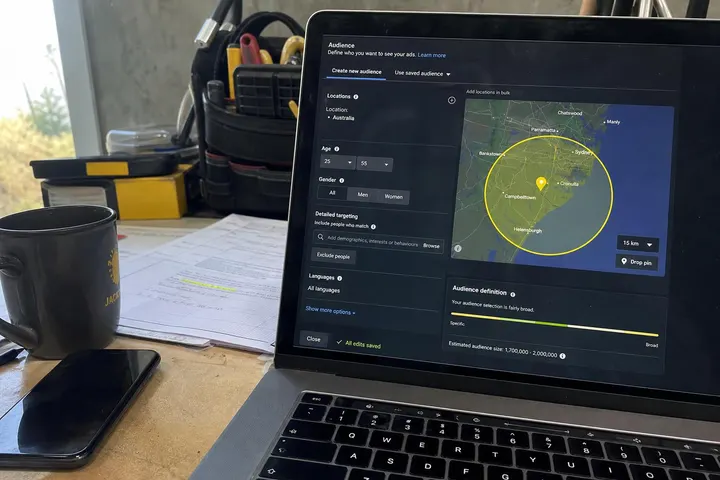
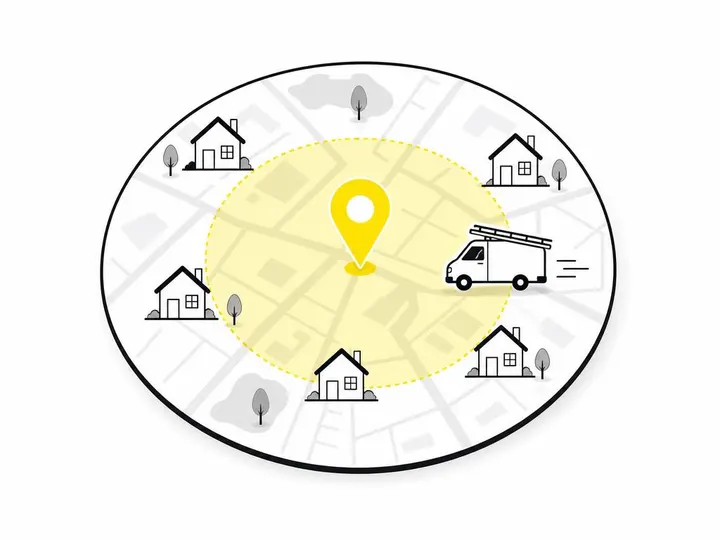
The single most powerful targeting lever you control is geography, and for most tradies a radius of 3 to 5 kilometres from your office or main job sites is where your best leads live.
Plumbers, electricians, painters, and other service trades work best with tight radius targeting because your profit depends on travel time. A job 2 kilometres away is profitable. A job 12 kilometres away eats into your margin. Meta lets you set exact radius targeting in Ads Manager. Use it. A 3 to 5 kilometre radius for these trades eliminates most waste.
Builders, landscapers, and specialty trades that can travel further or do bigger jobs can often expand to 10 to 15 kilometres. A landscape design company working on $50,000+ renovations can afford to drive further. A kitchen renovation specialist might serve the entire inner suburb cluster, not just one postcode. But start tight. You can always broaden if you're not getting enough volume.
Why 3 to 5 kilometre targeting works for most trades (plumbers, electricians, painters)
Your service area is where you make money. If it takes you 45 minutes to reach a job, your profit margin shrinks. Meta's radius targeting lets you focus every dollar on the people who are actually worth your time. A plumber in Chatswood targets 3 to 5 kilometres around their office. Cheap. Relevant. Profitable.
When to expand to 10 to 15 kilometres (builders, landscapers, specialty trades)
Larger jobs and premium services have bigger service radiuses. A high-end builder might serve the whole northern beaches. A pool builder can travel 15 kilometres for a $30,000 install. Expand your radius only when your job size or profit justifies the travel time.
How to set radius targeting in Meta Ads Manager (and avoid postcode mistakes)
In Ads Manager, go to Audience, then Location. Choose "People in this location" (not "interested in" or "people who recently travelled"). Select your address or suburb, then set your exact radius in kilometres. Don't rely on postcodes alone. Postcodes are ugly. A single postcode might sprawl 20 kilometres in rural areas and be only 2 kilometres in cities. Use address plus radius. Test your reach. If Meta says your audience is too small, you've gone too tight. Broaden by 1 to 2 kilometres and test again.
Layer 1: Demographic Targeting That Actually Matches Homeowners
Once your radius is locked, you need to exclude people who'll never hire you. Age, household income, and homeownership status are your weapons.
Most trades see the best results targeting homeowners aged 30 to 55 for general work (roof repairs, plumbing, electrical, painting) and 35 to 65 for renovation and premium services. These age groups have money, own their homes, and make decisions about home maintenance. A 22-year-old flat-sharer or a renter in their 40s isn't your customer. Exclude them.
Household income targeting is underused by tradies but powerful. Filter for $80,000 to $150,000+ household income (depending on your service price). A $5,000 kitchen renovation is accessible to most homeowners. A $50,000 renovation attracts higher-income households. Know your price point and exclude people who can't afford you.
Age ranges that convert: 30 to 55 for most trades, 35 to 65 for renovations
Tradies report best conversion rates with homeowners in these age brackets. Younger people rent. Older people own but may not have the capacity for big projects. The sweet spot is middle-aged homeowners with stable income and home maintenance budgets.
Household income targeting ($80,000+ for quality leads)
Filter for minimum household income that matches your service price. No point reaching people who can't afford you. A plumber targeting $3,000 jobs can go lower ($60,000+). A renovation specialist working on $30,000+ projects should target $120,000+.
Why excluding renters and students saves your budget
Renters can't approve structural work. Students have no maintenance budget. Meta lets you exclude these groups. Do it. Your cost-per-lead will drop immediately.
Layer 2: Interest and Behaviour Targeting (Use Sparingly)
After geography and demographics, interests and behaviours help, but too many layers shrink your audience to almost nothing and starve your campaign of reach.
Home improvement interests signal genuine intent. People who follow home renovation pages, follow contractor profiles, or engage with building content are more likely to hire. But don't over-layer. Adding three interests plus age plus income plus location creates an audience so small your campaign can't deliver volume. Add one or two interests if you want, but test without them first. Most tradies find that geography plus demographics already filter well.
Life events work. Meta can target people who recently moved house, got engaged, or became new homeowners. A new homeowner is likely thinking about maintenance. A recent mover might need repairs. Use these behaviours if available, but don't rely on them alone.
Home improvement interests that signal buying intent
Interests like "home renovation," "DIY," "gardening," and "interior design" show intent. But many are browser-only. Test including them, but measure whether they actually improve your cost-per-lead before keeping them in.
Life events: new movers, recently engaged, homeowners
New movers and new homeowners are high-intent audiences. People who just bought a house often need repairs, updates, or maintenance. Use these if Meta offers them for your area, but pair with your core geography and demographics.
Why you should avoid over-layering interests (shrinks reach too much)
Each interest you add multiplies your audience restrictions. Geography plus income plus two interests equals a tiny, expensive audience. Start simple: location, age, homeowner status. Add interests only if your reach is strong and you're testing to improve.
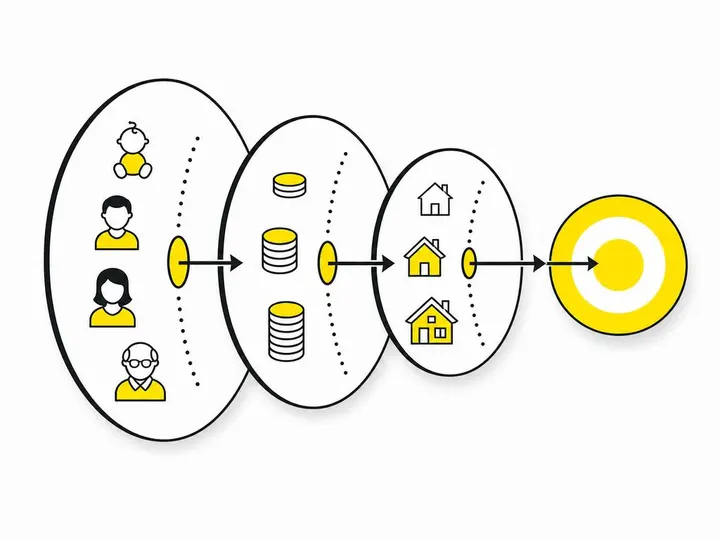
Advanced Targeting: Lookalikes, Retargeting, and Custom Audiences
Once you've got quality customers, use them to find more customers like them. Lookalike audiences, retargeting, and custom audiences are how you scale without losing efficiency.
A lookalike audience uses Meta's algorithm to find new people who behave like your best customers. You upload your customer list (emails, phone numbers, names) or use your website visitors. Meta finds thousands of similar people. These audiences convert well because they're modelled on real buyers.
Retargeting reaches people who've already seen your website or watched your videos. They know you exist. Your cost to convert them is usually lower than cold traffic. Install Meta's retargeting pixel on your website and build audiences of website visitors and video viewers. Run cheaper retargeting campaigns to people who've shown interest.
Building a lookalike audience from past customers or website visitors
Export your best customer list (or your past 90 days of website visitors) into a custom audience, then create a lookalike. Meta finds 1 to 10 percent of the Australian population who resemble your best customers. Start with 1 percent (closest matches) and test. Cost-per-lead often drops 20 to 40 percent.
Retargeting people who visited your site or watched your video
Everyone who visits your website gets tagged with the retargeting pixel. Later, you run cheaper ads to that audience. They've already considered you. Your cost to convert them is usually half cold traffic. Use this ruthlessly.
When to use custom audiences (email lists, phone numbers)
Upload your email list or past client phone numbers. Create audiences of these existing relationships. Run cheap, focused ads to people you've already worked with. They're warm leads.
What to Exclude: Keeping Tyre-Kickers and Time-Wasters Out
Negative audiences are as important as positive ones. Tell Meta who not to show your ads to, and your cost-per-lead drops.
Exclude DIY enthusiasts. People who follow budget renovation pages or "how to" content are browsing, not buying. They'll contact you for free advice, not to hire. Exclude them. Exclude job-seekers and industry competitors. Exclude people who've already converted (past customers don't need another lead ad).
Excluding DIY enthusiasts and bargain-hunters
Interests like "DIY" or followers of budget renovation pages often want free advice, not to hire. Exclude these interests if your leads are mostly tyre-kickers.
Filtering out job-seekers and competitors
Exclude job-seeker audiences and competitor interest lists. Your budget should go to potential customers, not your competition fishing for leads.
Using negative audiences to refine over time
As you run campaigns, create exclusion audiences. People who engaged but never converted? Exclude them from future campaigns. People who visited but didn't spend? Exclude them. Negative audiences get tighter and cheaper over weeks and months.

Testing and Tweaking: How to Know If Your Targeting Is Working
You measure success with three metrics: cost-per-lead, frequency, and click-through rate. If cost-per-lead is rising, your targeting is drifting. If frequency is above 4 to 5, people are seeing your ad too many times and ignoring it. If click-through rate is below 1.5 percent, your ad or your audience match is weak.
Cost-per-lead tells you whether your targeting is efficient. Under $5 per lead for local trades is excellent. $5 to $10 is acceptable. Over $10 means your audience is wrong or your ad is weak. Check your audience first.
If you're getting lots of leads but they're from far away, narrow your radius. If volume is too low, broaden slightly or add interests. If your frequency is above 5, your audience is too small. Expand your radius or remove interests.
Metrics to watch: cost-per-lead, frequency, click-through rate
Cost-per-lead under $8 is good for most trades. Frequency above 5 means over-exposure. Click-through rate below 1 percent signals weak targeting or weak ad creative.
When to narrow your radius (too many enquiries outside your patch)
If half your leads are outside your service area, your radius is too broad. Tighten it by 1 to 2 kilometres and retest. Less volume, but higher-quality leads.
When to broaden (not enough volume, low reach)
If Meta reports your audience is too small (under 50,000), expand your radius or remove interests. You need minimum volume to run an effective campaign.
Common Targeting Mistakes Tradies Make (and How to Fix Them)
Three mistakes show up again and again. Fix them and your cost-per-lead will improve immediately.
Mistake 1: Targeting the whole city or state
A tradie in Parramatta shouldn't target all of Sydney. You're paying to reach people 40 kilometres away who'll never call you. Set a strict radius, 3 to 5 kilometres for most trades, and stick to it. Your cost-per-lead will drop by 40 to 50 percent.
Mistake 2: Layering too many interests (audience too small)
Adding five interests to your targeting creates an audience so small Meta can't deliver. Start with zero interests. Add one if your reach is strong and you want to test. Most tradies don't need interests at all. Geography and homeowner demographics do the work.
Mistake 3: Never refreshing or testing audiences (ad fatigue)
The same person seeing the same ad ten times ignores it. Frequency rises, cost rises, conversion drops. Rotate your ads every two weeks. Create new audience segments. Use multiple ad copy angles and test. Refresh keeps campaigns fresh and costs down.
Conclusion
Meta Ads targeting for tradies isn't complicated, but it's precise. You start with geography (3 to 5 kilometres for most trades), layer in demographics (homeowners, age 30 to 55, income $80,000+), then use interests and negative audiences sparingly to filter in buyers and filter out tyre-kickers. Lookalike and retargeting audiences become your efficiency lever once you've built a customer base. You measure success by cost-per-lead and adjust your radius and interests based on volume and quality.
Most tradies can cut their cost-per-lead in half within two weeks by tightening their geographic radius and excluding renters. The second improvement comes from understanding what