Facebook Ad Frequency Too High? Here's What to Do
On this page 7 sections
Key takeaways
- Frequency = impressions divided by reach, always check it against a fixed date range
- No Meta-endorsed threshold exists, context determines whether frequency is healthy
- Prospecting and retargeting campaigns need separate frequency expectations
- Rising frequency plus falling results signals creative fatigue, not just a number to fix
- Rotate creative, broaden audiences or exclude recent converters before cutting budget
Your Facebook ad frequency has crept up to 4 or 5, and your cost per result is climbing. You're wondering whether that high frequency number means you're wasting money, or whether it's actually fine and something else is going wrong. The answer matters, because a frequency threshold that works for retargeting might be poisoning your prospecting campaign, and the solution depends entirely on what's driving the climb.
What Ad Frequency Actually Means (And How to Find It)
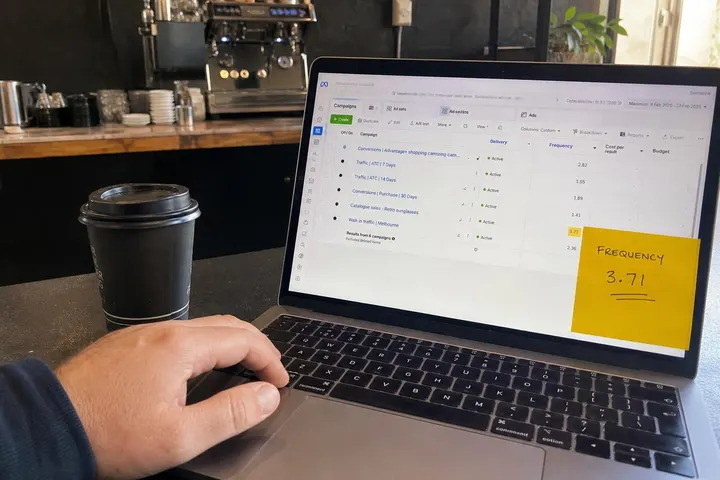
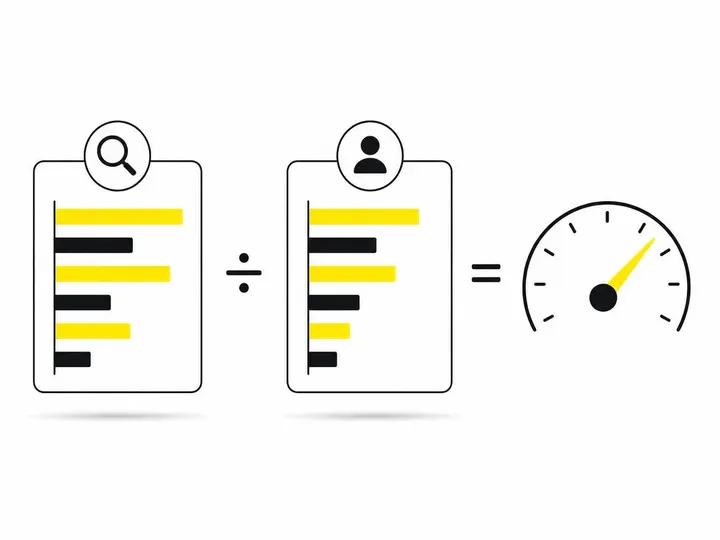
Ad frequency is simply the average number of times each person in your audience has seen your ad over a set period. Meta Ads Manager calculates it by dividing total impressions by reach. If your campaign generated 10,000 impressions and reached 2,000 people, your frequency is 5.0. That number sits right in the campaign, ad set, and placement breakdowns within Meta Ads Manager, usually under the "Delivery" column.
How frequency is calculated
The maths is straightforward: impressions divided by reach equals frequency. The tricky part is understanding what those numbers mean in context. An impression happens every time an ad appears on someone's screen, whether they notice it or not. Reach counts unique people. So a frequency of 2.0 means each person saw your ad an average of twice, but the distribution is never even. Some saw it once, others saw it ten times.
Where to find frequency in Meta Ads Manager
Open any campaign or ad set, then navigate to the "Results" or "Delivery" columns in your breakdown table. Frequency appears alongside impressions, reach, clicks, and cost per result. You can filter by date range, ad set, placement (Instagram Feed, Reels, Stories, Audience Network), and device. Most small business owners check at the campaign level first, but the real insight often hides in the ad set or placement breakdown. A frequency of 2.8 overall might hide one ad set sitting at 6.0 while another runs at 1.2.
Why the reporting period changes everything
A frequency of 2.0 over seven days is completely different from 2.0 over four weeks. The same frequency number can signal a healthy, focused retargeting push or a sign that your cold audience is exhausted. Always check your reporting period when you look at frequency. Changing the date range often explains why frequency suddenly looks high or low. A campaign running consistently for three weeks might show a frequency of 3.5, while the same campaign over just the last seven days shows 1.8, because fresh audience members entered during that week.
Is There a Magic Number That Means Frequency Is Too High?
No single frequency number triggers a "too high" warning across all campaigns, and Meta does not publish one. Research and benchmarks suggest ranges, but those ranges depend entirely on your audience type, campaign objective, and how long the ads have been running.
What Meta's own research says
Meta examined frequency across 2,439 Brand Lift campaigns between November 2019 and March 2020 and found that ad effectiveness plateaued after several impressions, but did not publish a universal threshold that applies to all businesses. Recent analysis from October 2026 confirms Meta's guidance allows frequency to vary substantially according to audience size, budget and campaign duration rather than setting a fixed benchmark. In other words, Meta studied the problem and concluded it depends.
Why popular benchmarks like 3.0 are not universal
You'll read that a frequency of 3.0 is ideal, or that anything above 4.0 is creative fatigue. These benchmarks come from practitioner experience and industry surveys, not from a disclosed Meta standard. One survey of mid-sized and large companies found a median frequency of 3.0, with the middle 50 percent sitting between 2.1 and 4.4, but that tells you nothing about small business patterns or whether those campaigns were actually profitable. Frequency recommendations for cold audiences often range from 1 to 3, while retargeting is considered acceptable at 5, 8, or even higher. The same number means different things depending on the campaign type.
The real signal: frequency rising while results fall
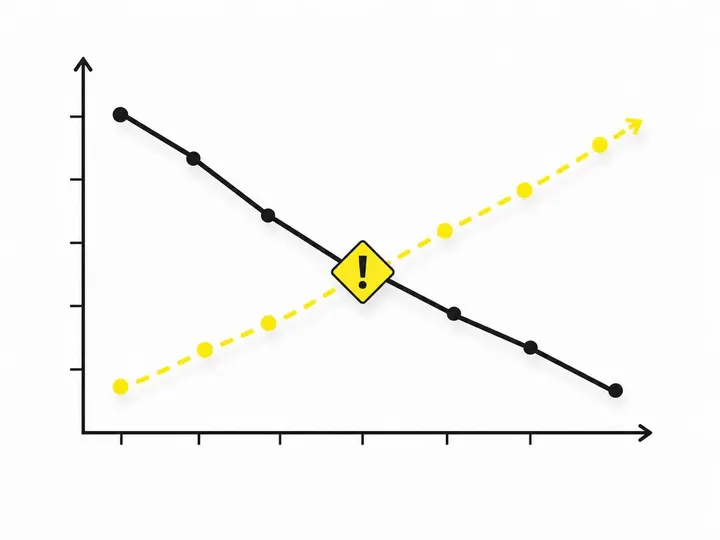
The useful question is not "Is my frequency too high?" but "Is my frequency rising while my performance falls?" If your frequency climbs from 2.0 to 4.5 over two weeks and your cost per result goes from $12 to $18, and your click-through rate drops from 1.2 percent to 0.7 percent, frequency is likely part of the problem. If your frequency is 5.0 but your cost per result is stable, your clicks are strong, and your conversions are rolling in, leave it alone. Business outcomes beat benchmark scores every time.
Prospecting vs Retargeting: Different Campaigns, Different Rules
A small business running ads to a cold audience of 5,000 people cannot sustain the same frequency as one running retargeting to 50,000 warm customers. The audience size and warmth completely change what "acceptable" frequency looks like.
Cold audiences and why frequency climbs fast
When you prospecting to people who've never heard of your business, a small targeting radius (say, interest-based or lookalike) means you're recycling the same people quickly. If your cold audience is only 3,000 people and your daily budget is $50, your frequency climbs fast because Meta has limited fresh people to show ads to. Frequency of 4 or 5 arrives within days. This is normal and expected. The problem only emerges when frequency climbs and your cost per result climbs alongside it, signalling that the audience is fatigued on that particular creative.
Retargeting pools and acceptable higher frequency
Retargeting audiences (website visitors, past purchasers, video watchers) naturally accept higher frequency because the audience is warm and smaller. Showing your ad 6, 8, or even 10 times to someone who visited your website last week is far more acceptable than showing it 10 times to a stranger. These people know your brand and are further down the buying journey. Their tolerance for repeated exposure is higher, and the conversion value justifies the frequency. A retargeting campaign sitting at a frequency of 7.0 is not automatically wasteful.
How audience size drives the problem for small businesses
Small Australian businesses often face tighter audience pools than large national brands. Your local service area, niche industry, or modest budget means your addressable audience is smaller. That makes high frequency arrive earlier and climb faster. If you're a plumber targeting Sydney's Inner West, your audience might be 8,000 people, not 80,000. That's why custom audiences in Meta Ads and retargeting strategies become more important for small businesses. They let you show more relevant ads to smaller pools without creative fatigue killing your return.
How to Tell If Your Frequency Is Actually Hurting You
High frequency only becomes a problem when it correlates with falling performance. Watch for these five symptoms together, not in isolation.
The five symptoms to watch
Frequency rising over the same period that cost per result climbs.
Click-through rate (CTR) declining while frequency increases.
Reach flattening or shrinking as frequency creeps up, meaning you're showing ads to fewer unique people more often.
Conversion rate falling, not just clicks becoming cheaper to generate, but actual sales or leads weakening.
Negative audience sentiment: increased comments, shares or messages questioning why they keep seeing the ad, or unfollows climbing.
Reading cost per result and click-through rate together
A single metric rarely tells the story. If cost per result rises from $8 to $12 but CTR stays flat at 1.3 percent, the problem may be landing page performance, not ad frequency. If cost per result stays at $10 but CTR falls from 1.8 percent to 0.8 percent as frequency climbs, frequency is almost certainly the culprit. Use the date range filter to track trends over the last 14 to 21 days. A single day of poor performance is noise. Two weeks of deteriorating CTR and rising cost per result alongside climbing frequency is a real signal.
When high frequency is fine and when it is not
High frequency is fine when performance is stable or improving. A retargeting campaign at 6.0 frequency with a cost per result of $5 and a 15 percent conversion rate is doing exactly what it should. High frequency is not fine when it's rising and performance metrics are falling. The distinction is crucial. Many small business owners panic at a frequency of 4.0 and cut the campaign, missing the chance to fix the actual problem with creative refresh or audience expansion.
Six Steps to Fix a Frequency Problem Without Wasting Budget
If frequency is climbing and your results are deteriorating, move through these steps in order.
Step 1: Confirm it is frequency causing the decline
Pull a 21-day report and compare the first week to the last week. Is frequency up? Are cost per result and CTR down? Are you reaching fewer unique people? If frequency is stable but cost per result is climbing, the problem is not frequency. It might be landing page quality, audience fit, or broader market shifts. Don't treat frequency as the culprit unless the numbers support it.
Step 2: Broaden your audience targeting
If you're prospecting to a narrow interest or lookalike audience, expand it slightly. Move from a 1 percent lookalike to a 2 or 3 percent, or broaden your interest targeting to include adjacent interests. This gives Meta more people to show ads to, reducing frequency pressure on your core audience. Test this change by creating a new ad set with the broader targeting while keeping your original running. Compare frequency and cost per result after one week.
Step 3: Rotate or refresh your creative
When frequency climbs and CTR falls, creative fatigue is the likely cause. Your audience has seen that ad too many times and stopped responding. When to refresh your ads depends on your frequency and performance, but a good rule is: if frequency exceeds 3.0 and CTR is falling, test new creative immediately. This doesn't mean starting from scratch. Try a different angle, a different image or video, a different headline, or a different offer. Creative testing for Meta Ads is one of the fastest ways to recover when frequency kills performance.
Step 4: Exclude recent converters and existing customers
If your campaign objective allows it, build a custom audience of recent purchasers or website converters and exclude them from your prospecting ads. These people have already converted, and showing them the same "buy now" ad 6 times wastes both frequency and budget. Building custom audiences takes five minutes and immediately reduces wasted impressions. This is especially valuable for small businesses with modest audiences, because every impression counts.
Step 5: Shorten the campaign window or increase budget
If you're committed to reaching a specific audience, you have two levers: time and money. Shortening the campaign from 30 days to 14 days means higher frequency over a shorter window, which can trigger urgency and faster conversions. Increasing your daily budget spreads your ads across more people, reducing frequency on individuals. Which one works depends on your business model. A time-sensitive offer suits a short, high-frequency burst. A long-term lead-generation play suits a modest budget over a longer window with lower frequency.
Step 6: Split prospecting and retargeting into separate ad sets
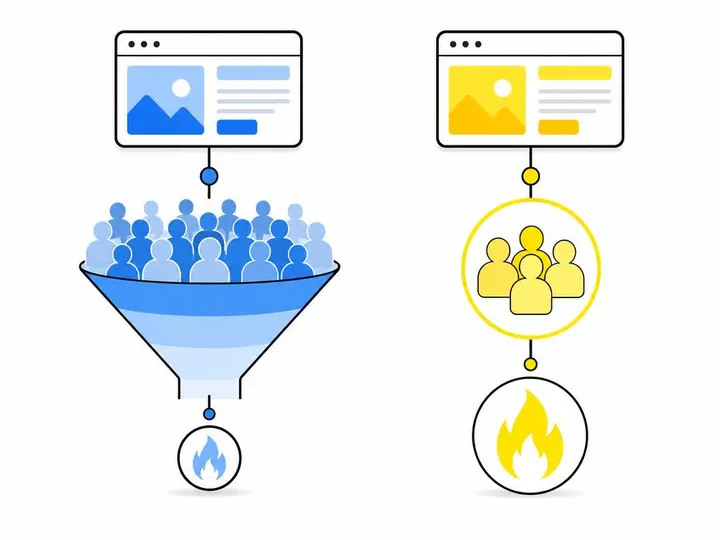
Many small businesses run cold prospecting and warm retargeting in the same ad set, which makes frequency analysis impossible and wastes impressions. Create separate ad sets for prospecting (new audiences) and retargeting on Facebook. This lets you set different budgets, use different creative, and tolerate different frequencies. Retargeting can run at 6 to 8 frequency with high ROI while prospecting runs at 2 to 3. Splitting them reveals which part of your funnel is actually working.
Localising This for Australian Small Businesses in 2027
Australian social advertising expenditure projected to reach $8.76 billion in 2026, up 16.5 percent year on year. That rising competition for attention makes frequency management more critical for Australian small businesses in 2026 than it was three years ago. More advertisers chasing the same audience means frequency climbs faster and audience fatigue sets in earlier.
Facebook advertising reach of 24.7 million Australians in September 2026 remains substantial, and Facebook continues to drive 73 percent of Australian social-media referrals, making it essential for local business. But that reach doesn't mean individual audiences are large. A local service business targeting a specific Australian postcode or region still faces small audience pools. Judge your frequency not against global benchmarks or large-business standards, but against your own conversion data and customer acquisition cost. If your local retargeting frequency is 5.0 and your cost per qualified lead is $8, that's working. If your prospecting frequency is 3.0 and cost per lead is $22, something needs to change.
Get a clear view of your current campaigns by running a free ads audit. A quick check of your frequency patterns across ad sets often reveals that one campaign is responsible for most of the issue, and fixing it is simpler than overhauling your entire strategy.
Conclusion
Facebook ad frequency is not a fixed threshold you either hit or miss. It's a diagnostic signal that matters only when it correlates with falling business results. A frequency of 4.0 or 5.0 is perfectly acceptable for retargeting warm audiences or short-burst prospecting campaigns. The same frequency is wasteful for a small cold audience running the same creative for six weeks. The fix depends on understanding what's actually happening in your campaign: whether frequency is rising alongside cost per result and falling CTR, whether your audience is too small, and whether your creative needs refreshing.
Start by confirming frequency is the culprit, not a symptom of something else. Then move through the steps: broaden your audience, test new creative, exclude converters, adjust your budget or timeline, and separate prospecting from retargeting. In the increasingly competitive Australian social advertising market of 2026, small businesses that monitor frequency and act quickly recover faster than those chasing arbitrary benchmarks. The business outcome is what matters. Frequency is just the tool that helps you spot the problem.