Dental SEO Keywords: How to Find Treatment Searches That Bring New Patients
On this page 8 sections
Key takeaways
- Group keywords by treatment, intent and location rather than one big list
- Cost searches like 'Invisalign cost' attract patients early in their decision
- Emergency searches need same-day availability and hours front and centre
- One useful page per service beats thin suburb pages with duplicate copy
- Ahpra rules mean you cannot use specialist titles unless a registered specialist is present
- Validate keyword volumes in Search Console and your own booking data
Most dental clinics start their keyword strategy with "dentist near me" or generic terms that millions of Australian patients search for every month. But that's where most clinics stop, missing the high-intent treatment searches where prospective patients are actively deciding between providers and ready to book. This article shows you how to map the keywords that actually bring new patients through your door, from emergency searches to implants, orthodontics and children's dentistry, then validate those keywords using the tools and data you already have access to.
Why 'dentist' alone is not a dental SEO keyword strategy
A single page targeting "dentist" or "dentist near me" cannot serve every patient intent, location need or urgency level that matters to your practice. Patients searching for emergency care, orthodontic treatment, implants or children's services are not all looking for the same thing, and a generic homepage ranks poorly for those specific searches while also failing to answer the questions that convert them.
How Australian patients actually search for dental care
Recent analysis of search behaviour across Australia in October and November 2026 shows that local search optimisation is not one-size-fits-all. Patients narrow their searches by treatment type, location and urgency. "Emergency dentist near me" accounts for approximately 2,600 monthly searches, with a further 1,900 for "emergency dentist" alone. "Invisalign cost" attracts about 5,900 monthly searches. "Children's dentist" is a distinct search with its own audience and intent. Each of these queries deserves its own page, optimised for the people asking it, not buried under a generic dental homepage.
What the volume data tells you (and what it does not)
Keyword volume estimates vary wildly between tools. Ahrefs reported approximately 31,000 monthly searches for "dentist near me" on 25 October 2026, while Humming Web's analysis on 3 November 2026 suggested approximately 60,500, and Click Click Media reported approximately 135,000 based on Google Keyword Planner data covering the 12 months to August 2026. These numbers should guide your priorities, not dictate them. What matters more is whether your local audience is searching for that term right now, in your suburbs, for the services you offer. Volume figures also don't tell you search intent, local competition or how many of those searches are high-intent patients ready to book versus people still researching. Use Google Search Console to find keywords your site already ranks for, then validate demand with your own call and booking data.
The five keyword groups every dental clinic should map
Segment your keyword research by service, intent and urgency. This strategy creates a clearer roadmap than trying to rank for everything at once.
1. Emergency and urgent care searches
"Emergency dentist near me", "dentist open Saturday", "broken tooth dentist" and similar queries represent patients with immediate pain or damage, ready to call today. These searches are answered primarily through Google's local pack (Maps results), where opening hours, distance, phone contact and positive reviews drive clicks faster than organic rankings. Ensure your Google Business Profile is accurate and includes same-day availability indicators.
2. Implant searches
"Dental implants [suburb]", "single tooth implant cost", "implant consultation" and "how much do dental implants cost" bring patients researching a significant investment. These are mid-to-high-intent searches where detailed treatment pages that explain the process, risks, recovery, who performs the procedure and what to expect convert better than generic clinic pages.
3. Orthodontic and aligner searches
"Clear aligners [suburb]", "Invisalign cost", "braces for adults" and "orthodontic consultation" attract a distinct audience often concerned with aesthetics, comfort and affordability. Cost-focused searches like "Invisalign cost" (approximately 5,900 monthly searches) represent patients comparing options before contact.
4. Children's dentistry searches
"Children's dentist [suburb]", "kids dentist near me", "first dental visit" and "gentle dentist for children" target parents and guardians. These searches often include reassurance language because parents want to know the clinic is experienced with anxious or young patients. Dedicate content to what happens during a first visit and how your team manages nervous children.
5. General and new-patient searches
"Dentist near me", "dental check-up [suburb]", "new patient dentist" and "dental cleaning" form your baseline. These are higher-volume but lower-intent searches; many are people still deciding whether to book at all. Combine these with suburb-based pages if your practice genuinely serves multiple areas, but avoid creating thin duplicates.
Cost searches: the content opportunity most clinics ignore
Patients ask Google about dental costs before they call you, yet many clinics publish nothing about fees, fearing legal risk or preferring to quote in person. This leaves money on the table and frustrates patients who need budgeting clarity.
"Wisdom teeth removal cost" attracts approximately 3,900 monthly searches, "teeth whitening cost" around 1,000, and "dental implants cost" about 600. These are not casual browsers; they are people evaluating suitability and affordability. Publish a fee guide or "what affects cost" page for each major treatment without committing to exact prices. For example, explain that implant costs depend on bone density, restoration type and whether specialist work is needed, then provide a typical range (e.g., "$3,000 to $8,000 as an estimate"). Always note that costs vary and an assessment is required for a confirmed quote. This approach satisfies both Ahpra advertising guidelines for dentists, which prohibit misleading or unsubstantiated cost claims, and patient expectations for transparency.
One page per genuine service: how to structure treatment pages
Create a distinct page for each service your practice genuinely provides, not a suburb page that repeats the same treatment information with a suburb name swapped in.
What each treatment page must cover
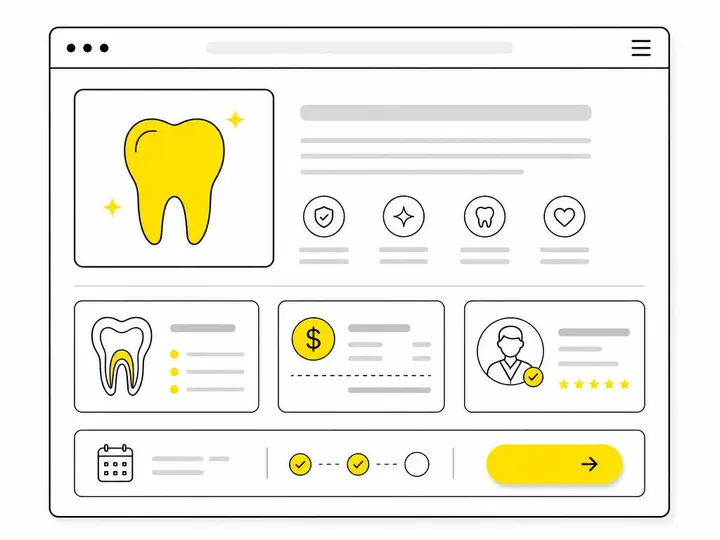
Every treatment page should answer the questions that convert searchers into patients. Include who performs the treatment (name, qualifications and registration status to meet Ahpra compliance), what the procedure involves, why it might be needed, potential risks or side effects, typical recovery or aftercare, what patients should expect in cost terms, payment options or financing, and a clear call to action (phone, email, online booking). This structure also works for AI search experiences, where conversational queries reward comprehensive, well-structured content over keyword-stuffed thin pages.
Suburb pages: when they help and when they hurt
If your clinic genuinely serves multiple suburbs (e.g., you have branches or travel to community health centres), suburb-specific pages can help. But avoid creating dozens of suburb pages with identical content except for place names; Google penalises thin, duplicate-content suburb landing pages. If you create them, ensure each page reflects real differences (different opening hours, different staff, different parking arrangements) or focus instead on one strong local page plus a Google Business Profile content plan optimised for multiple service areas.
Ahpra compliance: titles and claims you cannot make
Do not use specialist titles such as "orthodontist", "periodontist" or "implant specialist" unless an appropriately registered specialist works at your clinic address. List your staff by name, actual registration type and real qualifications only. Avoid language that implies guaranteed outcomes (e.g., "we cure gum disease" instead of "we treat gum disease"). Ahpra advertising guidelines for dentists are specific and enforceable; breaching them can result in complaints to your regulator.
Local SEO and Google Business Profile: where urgent searches get answered
For emergency and urgent searches, Google's local pack (Maps results) ranks above organic search results, and most clicks land there first. Your Google Business Profile is where urgent patients find your phone number, hours, distance and booking link before they ever visit your website.
Keep your profile up to date: opening hours (including holiday closures), accurate address and suburb, phone number, website URL, services and categories (choose only those your practice offers), practitioner names and credentials (with registration numbers if visible), and latest reviews. Link your booking system if you offer online appointments. This signal feeds both local search rankings and organic SEO, and it directly influences whether patients call or click to another clinic.
How to validate your keyword choices using free tools
Paid keyword tools are useful, but start with what you already have or can access for free.
Use Google Search Console for keyword research to see which queries currently drive traffic to your site, your average ranking position for each, and how many impressions and clicks you get. This reveals unmet demand: searches where you rank on page two or three but aren't converting clicks yet. Google Keyword Planner provides directional volume and trend data free; remember it's tied to Google Ads auction activity, so it skews toward high-intent or high-spend queries. Your own call and booking data is the most honest signal. If you receive 15 calls a month from "emergency dentist near me" but zero from a low-volume term, prioritise the high-volume query. Track which keywords and pages drive conversions in your booking system or CRM, then allocate content effort accordingly.

AI search and conversational queries: what changes for dental SEO
As patients increasingly ask AI search systems conversational questions (e.g., "is Invisalign suitable for gaps between teeth?" or "how long do dental implants last?"), AI-assisted search experiences reward comprehensive, clearly structured treatment content over thin keyword-stuffed pages. A page that answers common questions about implant longevity, suitability, recovery time and cost factors will rank and be quoted by AI systems more reliably than a page built around "implant", "cost" and "near me" repeated five times.
Write for humans first, optimise for search engines second. Use clear headings, short paragraphs, bullet-point lists for steps or criteria, and natural language. This approach works for traditional Google search, AI search and your Google Business Profile all at once.
Conclusion
Dental SEO keywords are not one generic list. They are five or more distinct keyword groups (emergency, implants, orthodontics, children's dentistry and general care), each with its own search intent, geography and urgency. Map these groups, create one useful page per genuine service, validate demand in Google Search Console and your own booking data, and keep your Google Business Profile accurate for local urgency searches. Publish cost transparency where Ahpra compliance allows, write comprehensive treatment pages that answer the questions behind high-intent searches, and ensure practitioner credentials and specialist claims are accurate and registered.
Start by auditing the keywords your site already ranks for in Search Console, then identify the gaps (treatments you offer but don't rank for, or high-volume searches your area clearly needs). Prioritise emergency and urgent care visibility on your Google Business Profile first, since most urgent clicks come from local results. Then build treatment pages that genuinely explain what patients need to know: who does it, how it works, what it costs, and how to book. This strategy attracts patients earlier in their decision journey and converts them at higher rates than generic homepage-focused SEO.