The challenge
Engagement: February 2024 to March 2025. Platform: Shopify. Market: Australia. Services: technical SEO, on-page, content, UX and conversion rate optimisation.
Pet ID Tags Australia has sold engraved dog and cat tags, collars and accessories since 2002. In February 2024 the store was getting about 677 organic visits a month (a third-party estimate; the store had no reliable analytics history), only 43 keywords ranked in Google’s top 3, and the domain had a Domain Rating of 9. Our audit found 14 problems in four areas:
- Duplicate products and structure: the same tag was listed as a separate product for each colour or style, with near-identical titles and descriptions, so the pages competed with each other and none ranked well. Tags were not grouped by pet, shape or material, so no single page owned a search like “stainless steel dog tags”, and products and collections rarely linked to each other.
- Content: collection pages had no text at all, only a grid of products. Product pages repeated the same short copy and did not cover size, material, engraving or what to put on a tag. The few blog posts were short, did not target real searches and did not link to products. Many pages used default Shopify titles or repeated the same title across products.
- Technical SEO: Shopify’s duplicate product URLs (one per collection) added to the duplication; tag and filter pages were open to Google, which crawled them instead of real products; large images and app scripts slowed pages down; products had no complete Product or Offer schema; and with a Domain Rating of 9 the site struggled against larger pet retailers.
- UX and conversion: shoppers found it hard to compare tags, check sizes and see how engraving would look. Product pages had few trust signals and unclear calls to action, with reviews, delivery times and the guarantee far from the Add to cart button, and the menus mixed tags, collars and accessories so the right tag took too many clicks to find.
Our approach
First we merged the duplicate products and fixed the technical problems. Then we added content to every key page. Then we improved the shopping experience so more of the new visits became orders.
- Remove duplication and fix the foundation (Feb to May 2024). We merged similar products into single products with colour and style variants and redirected the old URLs, so each tag has one strong page that collects all its ranking signals and reviews. We set canonicals on the duplicate product URLs, noindexed tag and filter pages, compressed images, removed unused apps and scripts, added Product, Offer and Breadcrumb schema, and rewrote titles, meta descriptions and H1s around real search terms.
- Add content and structure (Jun to Oct 2024). We grouped the collections by pet, shape and material and wrote copy and FAQs for the collection pages that had none. We rewrote product descriptions with size, material and engraving details, rewrote the thin blog posts and published guides such as what to put on a dog tag, and linked guides to collections and collections to products.
- Improve UX and conversions (Nov 2024 to Mar 2025). We simplified the menu so shoppers reach the right tag in fewer clicks, moved reviews, delivery times and the money-back guarantee next to Add to cart, made sizes, materials and engraving limits clear on every product page, and built links from relevant pet and Australian business sites.
The results
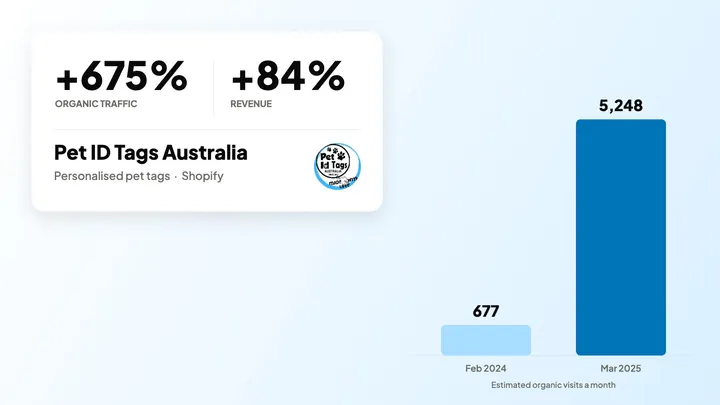
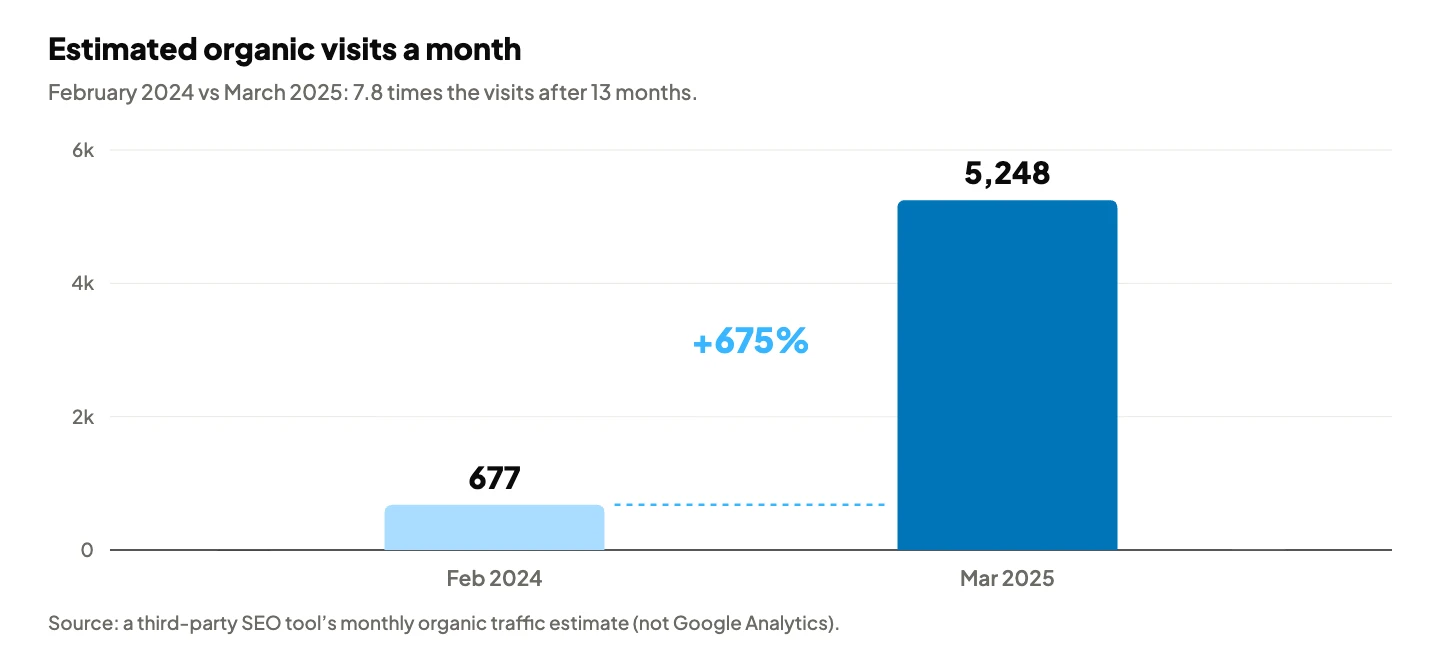
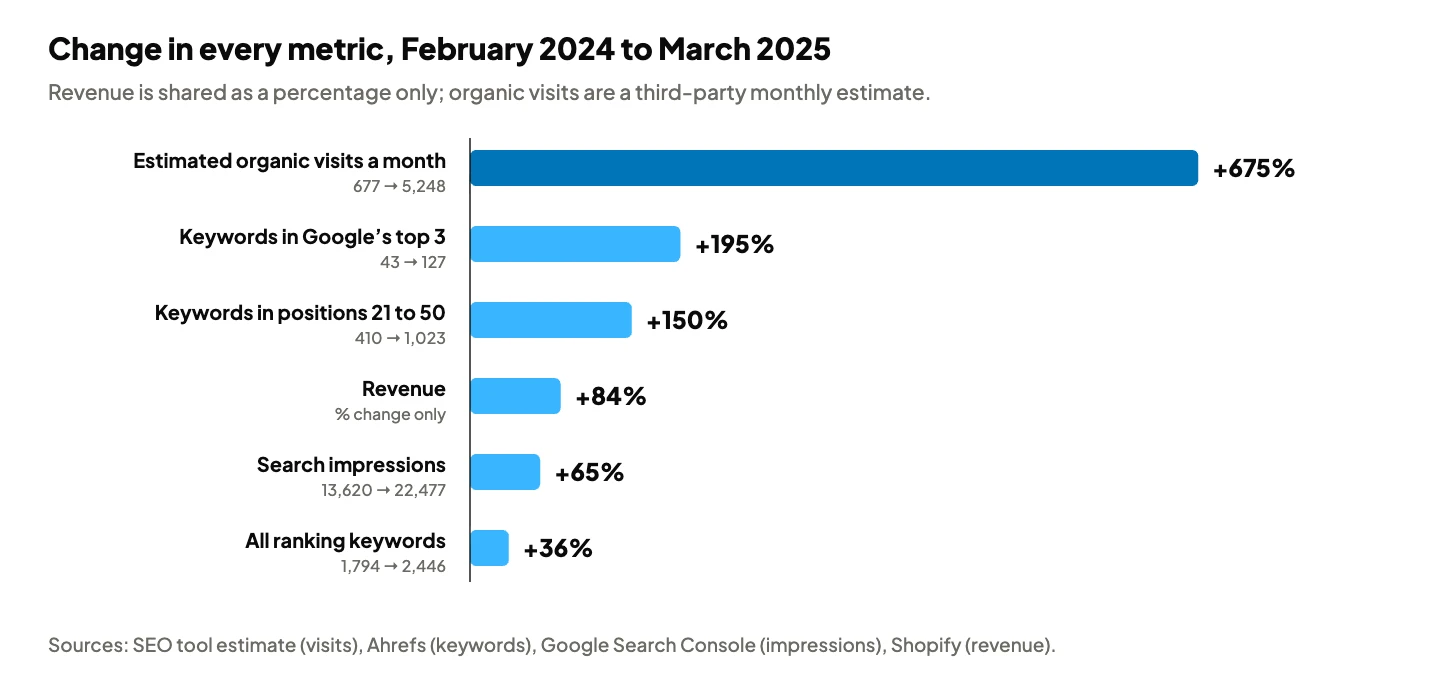
Estimated organic visits increased from 677 a month in February 2024 to 5,248 a month in March 2025, 7.8 times the starting figure (+675%). Over the same period the store’s revenue increased 84%.
Rankings
Keywords in Google’s top 3 increased from 43 to 127 (+195%) as each merged product and each rewritten collection page became the one page for its search. The number of keywords in positions 21 to 50, the pages queued up for page one and two, increased from 410 to 1,023 (+150%), and the store ranked for 2,446 keywords in all, up from 1,794 (+36%).
Impressions and authority
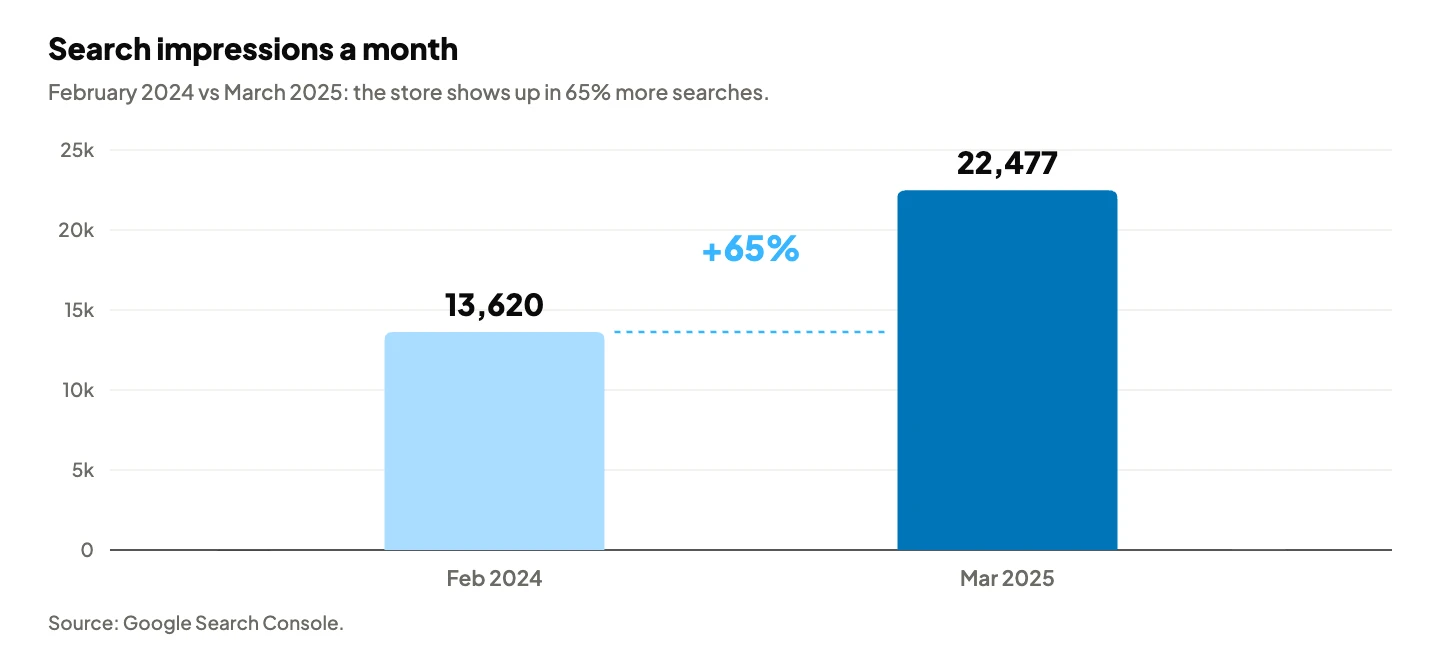
Search impressions increased from 13,620 to 22,477 a month (+65%), and links from relevant pet and Australian business sites lifted the Domain Rating from 9 to 12, enough for the category pages to compete with larger pet retailers on tag searches.
Revenue
Revenue increased 84% over the project. The client’s figures stay private, so this is shared as a percentage only. The UX work in the last phase is what turned the new traffic into orders: a simpler menu, clear sizes and engraving limits, and reviews, delivery times and the guarantee next to Add to cart.
Every result, before and after
| Metric | Feb 2024 | Mar 2025 | Change | Source |
|---|---|---|---|---|
| Organic visits a month (estimated) | 677 | 5,248 | +675% | SEO tool estimate |
| Search impressions | 13,620 | 22,477 | +65% | Search Console |
| Keywords in Google’s top 3 | 43 | 127 | +195% | Ahrefs |
| Keywords in positions 21 to 50 | 410 | 1,023 | +150% | Ahrefs |
| All ranking keywords | 1,794 | 2,446 | +36% | Ahrefs |
| Domain Rating | 9 | 12 | +3 | Ahrefs |
| Revenue | % change only | +84% | Shopify |
What we fixed, and what changed
| Issue we found | What we did | What changed |
|---|---|---|
| Too many similar products | Merged them into single products with variants and redirected the old URLs | One strong page per tag instead of several weak ones |
| No content on key pages | Copy and FAQs for every key collection page | Collection pages now rank for category searches |
| Thin product descriptions | Rewrote them with size, material and engraving details | Products answer shoppers’ questions on the page |
| Thin blog content | Rewrote thin posts and published guides that link to products | Guides bring in shoppers researching tags |
| Missing and duplicate titles, metas and H1s | Rewrote them around real search terms | Keywords in the top 3 from 43 to 127 |
| Duplicate URLs, tag and filter pages | Canonicals and noindex on duplicate and filter URLs | Google crawls the pages that matter |
| Slow pages and missing schema | Image and app cleanup; Product, Offer and Breadcrumb schema | Faster pages and richer search results |
| Low domain authority | Links from relevant pet and Australian business sites | Domain Rating from 9 to 12 |
| Poor UX, weak conversion setup, confusing navigation | Simpler menu, trust signals next to Add to cart, clearer product details | Revenue up 84% |
Two lessons for Shopify stores with many similar products. Merge similar products into variants: listing every colour as its own product creates pages that compete with each other, while one product with variants collects all the ranking signals and reviews in one place. And fix UX alongside SEO: more traffic only helps if shoppers can find the right product and trust the store.
Sources: a third-party SEO tool’s monthly organic traffic estimate (not Google Analytics), Google Search Console (impressions), Ahrefs (keyword positions, Domain Rating) and Shopify (revenue, shared as percentage change only). February 2024 vs March 2025.